
Conventional solvent extraction of plant materials is a slow process — maceration may run for hours or days, soxhlet extraction requires elevated temperatures and large solvent volumes, and steam distillation imposes thermal stress that damages thermolabile compounds. Ultrasound-assisted extraction (UAE) offers a fundamentally different mechanism: acoustic cavitation disrupts plant cell walls, accelerates solvent penetration, and releases target compounds in minutes rather than hours.
For the extraction of tea polyphenols, traditional Chinese medicine actives, essential oils, anthocyanins, alkaloids, flavonoids, cannabinoids, and food-derived bioactive compounds, UAE has become a standard method in research and a commercially attractive option for production. This guide explains the mechanism, key parameters, protocols for common matrices, and how to select the right equipment.
Key takeaways
- UAE cuts extraction time to 5–20 minutes versus hours or days for maceration or soxhlet.
- Solvent use drops 50–80% while target-compound yields rise 20–50% over maceration.
- 20 kHz probe sonication beats 40–80 kHz baths, with 10–100x higher intensity per volume.
- Optimal extraction is typically 20–40°C; pulsed mode protects heat-sensitive compounds.
- SONOBIO lines span Handheld (120 W) to Industrial (2000 W, up to 50 L); probes excluded from the 1-year warranty.
How Ultrasound-Assisted Extraction Works
When an ultrasonic probe operates in a solvent-plant matrix slurry, cavitation creates three simultaneous effects that collectively accelerate extraction:
1. Cell wall disruption. The mechanical forces of cavitation collapse rupture plant cell walls and disrupt the cuticle and intracellular compartments. This releases intracellular compounds directly into the solvent rather than relying on diffusion through intact cell membranes.
2. Mass transfer enhancement. The turbulent micro-mixing and micro-streaming generated by cavitation drive solvent into cracked cell structures and carry dissolved compounds away from the particle surface into the bulk solvent. The effective boundary layer between solid and liquid is dramatically thinned.
3. Thermal assistance (limited). Local temperature rise at cavitation sites can accelerate solubility of target compounds, but bulk temperature is easily controlled — unlike reflux or soxhlet conditions, UAE can be performed at or near room temperature, which is critical for thermolabile compounds.
The combined result: extraction times shrink from hours to minutes, solvent consumption drops by 50–80% versus conventional methods, and yields of target compounds typically increase by 20–50% in well-optimized UAE protocols compared to maceration controls.
Key Process Parameters
Ultrasonic Frequency
Tip: For botanical extraction, use a 20 kHz probe rather than a bath sonicator for far higher intensity and shorter processing times.
At 20 kHz (the operating frequency of most SONOBIO probe sonicators), cavitation bubbles are large and their collapse is violent — ideal for disrupting tough plant cell walls and woody matrix. Higher frequencies (40–80 kHz, as available on bath sonicators) produce smaller, less intense bubbles better suited to gentle matrix degradation.
For most botanical and food extraction applications, 20 kHz probe sonication outperforms bath sonication at any frequency because:
- Probe delivers energy directly at the solid-liquid interface
- Intensity is 10–100× higher per unit volume
- Processing time is 5–10× shorter
Solvent Selection
Solvent polarity should match the target compound class:
- Polar/hydrophilic targets (polyphenols, tannins, sugars, amino acids): water, aqueous ethanol (50–70%), methanol
- Mid-polarity targets (flavonoids, alkaloids, glycosides): ethanol (70–95%), aqueous acetone, ethyl acetate
- Non-polar targets (essential oils, fat-soluble vitamins, carotenoids, waxes): hexane, ethyl acetate, supercritical CO₂
Solid-to-Solvent Ratio (S/L)
Higher S/L ratios increase productivity per unit volume but can reduce extraction yield per gram of plant material. Typical starting ratios:
- 1:10 to 1:20 g/mL for most botanical powders (fine milling increases surface area and yield)
- 1:5 to 1:10 g/mL for fibrous or woody matrix with pre-milled powder (<250 µm)
Amplitude and Time
- For moderate plant matrices (tea, herbs, dried fruit): 30–50% amplitude, 5–15 minutes total active processing
- For tough matrix (bark, roots, seeds, dried citrus peel): 50–70% amplitude, 10–20 minutes
- Use pulsed mode (5 s on / 5 s off) to limit bulk temperature; ice bath recommended for heat-sensitive actives
Temperatura
Warning: Keep anthocyanins below 60°C and use pulsed sonication to avoid degrading heat-sensitive compounds like vitamin C.
Temperature affects solubility and stability. For most polyphenol extractions, 20–40 °C is optimal: warm enough to improve solubility without degrading compounds. SONOBIO models with a temperature probe enable automatic shutoff at a defined threshold, preventing overheating without continuous operator attention.
Extraction Protocols for Common Matrices
Protocol 1: Green Tea Polyphenols (EGCG, Catechins)
Matrix: Dried green tea leaves (ground to <500 µm)
Target: Catechins, EGCG, total polyphenols
Equipment: SONOBIO Integrated-Type or Split-Type, Φ12.7 mm probe
| Parameter | Value |
|---|---|
| Solvent | 70% aqueous ethanol |
| S/L ratio | 1:15 g/mL |
| Temperatura | 25–35 °C (maintain with ice bath) |
| Amplitude | 40% |
| Pulse mode | 5 s on / 5 s off |
| Total active time | 10 minutes |
Post-processing: filter through Whatman No. 1 paper; HPLC quantification against catechin/EGCG standards. Expected polyphenol yield increase vs. 30-min cold maceration: 30–60%.
Protocol 2: Traditional Chinese Herbal Extract (Quercetin from Sophora japonica Buds)
Matrix: Dried Sophora japonica flower buds (ground)
Target: Quercetin, rutin (quercetin-3-rutinoside)
Equipment: SONOBIO Split-Type, Φ12.7 or Φ20 mm probe
| Parameter | Value |
|---|---|
| Solvent | 60% aqueous ethanol |
| S/L ratio | 1:10 g/mL |
| Temperatura | 40 °C |
| Amplitude | 50% |
| Pulse mode | 5 s on / 5 s off |
| Total active time | 15 minutes |
The 15-minute UAE protocol has been shown in published literature to achieve comparable or superior quercetin extraction to 2-hour room-temperature maceration using 2–3× less solvent.
Protocol 3: CBD / Cannabis Extraction
Matrix: Dried cannabis flower or hemp biomass (coarsely ground)
Target: CBD, THC, full-spectrum cannabinoids and terpenes
Equipment: SONOBIO Split-Type (1200–2000 W), Φ20–30 mm probe for pilot scale
| Parameter | Value |
|---|---|
| Solvent | Ethanol (food-grade, 95%) |
| S/L ratio | 1:5 to 1:10 g/mL |
| Temperatura | −20 °C (cryo-extraction) to 20 °C |
| Amplitude | 50–65% |
| Pulse mode | 5 s on / 5 s off |
| Total active time | 10–20 minutes per batch |
Cryogenic ethanol extraction (−20 °C) reduces co-extraction of fats and chlorophylls, simplifying post-processing. The sonicator operates at low temperature; ensure vessel sealing for volatile terpene recovery.
Protocol 4: Anthocyanins from Berries / Grape Pomace
Matrix: Freeze-dried berry powder or grape pomace
Target: Anthocyanins, total phenolics
Equipment: SONOBIO Integrated-Type or Split-Type
| Parameter | Value |
|---|---|
| Solvent | 50% ethanol + 0.1% HCl (acidified) |
| S/L ratio | 1:20 g/mL |
| Temperatura | 25 °C |
| Amplitude | 35–45% |
| Pulse mode | 5 s on / 5 s off |
| Total active time | 8 minutes |
Acidified solvents stabilize anthocyanin structure during processing. Avoid high temperature and prolonged processing; anthocyanins degrade above 60 °C.
Protocol 5: Essential Oil Extraction (Ultrasound-Assisted Steam Distillation)
UAE can be combined with steam distillation by sonicating the botanical material during distillation. Alternatively, UAE using organic solvent (hexane or ethanol) prior to distillation pre-disrupts cells and significantly shortens distillation time while improving yield.
Pre-UAE protocol for lavender, rosemary, or mint:
- Solvent: hexane or 70% ethanol (hexane recovered by evaporation before steam distillation)
- Amplitude: 50–60%, 5–10 minutes active
- Proceed to standard steam distillation; distillation time reduces by 30–50%
UAE vs. Conventional Extraction Methods
| Parameter | Maceration | Soxhlet | Reflux | UAE (Probe) |
|---|---|---|---|---|
| Extraction time | Hours to days | 2–6 hours | 1–3 hours | 5–20 minutes |
| Solvent consumption | High | High | Medium | Low (50–80% reduction) |
| Temperatura | Ambient | High | High | Controllable, near-ambient |
| Thermolabile compound risk | Low | High | High | Low |
| Throughput | Low | Low | Medium | High |
| Equipment cost | Very low | Low | Medium | Medium |
| Scale-up | Easy | Difficult | Moderate | Straightforward |
Scale-Up: From Lab to Production
One advantage of probe sonication is predictable scale-up based on power density (W/mL):
- Lab scale (1–5 L): SONOBIO Split-Type with Φ20–30 mm probe at 1200–2000 W. Batch or semi-batch with ice-bath temperature control.
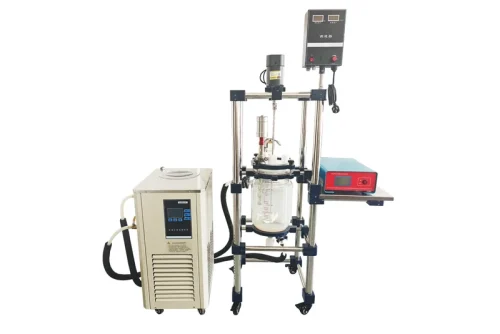
- Pilot scale (5–50 L): SONOBIO Industrial with Φ40–50 mm probe and 2000 W real power, jacketed vessel with external chiller.
- Production scale (continuous): SONOBIO Industrial with inline flow cell. The extract slurry flows through the sonication chamber at a controlled rate, enabling continuous extraction with defined energy dose per unit volume. Throughput limited only by feed rate and separator capacity.
For most botanical extract producers moving from bench research to production, the Split-Type (up to 5 L) covers the R&D and pilot stages, and the Industrial model covers pre-production and small-batch commercial runs.
What Sino Sonics Supplies
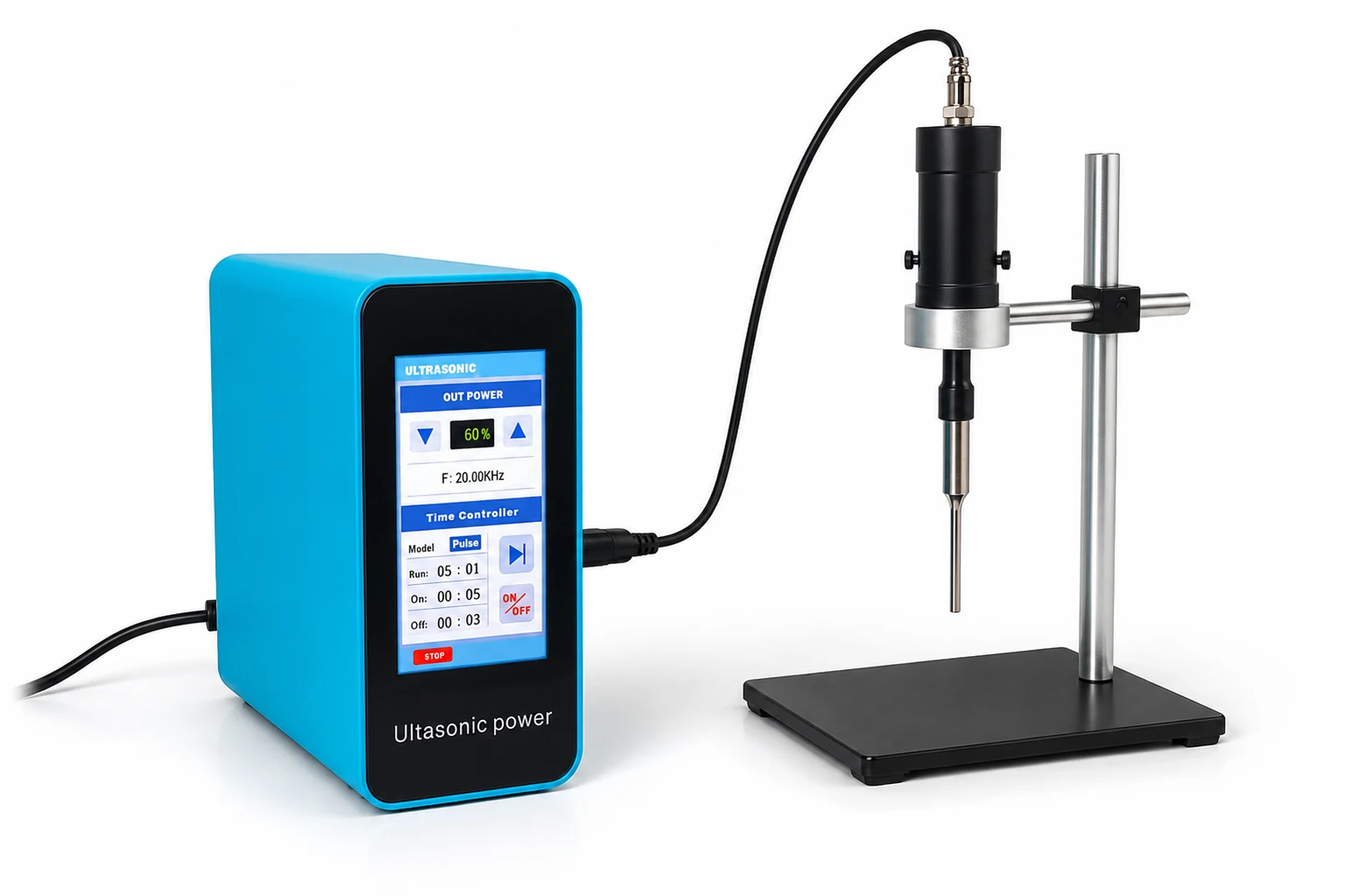
Sino Sonics SONOBIO ultrasonic homogenizers for extraction applications include:
- SONOBIO Handheld (120 W, 20 kHz): rapid screening of extraction solvents and parameters at small scale; 0.3–500 mL
- SONOBIO Integrated-Type (800 W, 25 kHz): lab standard for 0.5 mL–3 L extraction batches; built-in sound enclosure; temperature probe option
- SONOBIO Split-Type (1200–2000 W, 20 kHz): mid-scale extraction up to 5 L; Φ3–30 mm probe range; temperature + energy real-time display; programmable multi-step programs for reproducible protocols
- SONOBIO Industrial (2000 W real power, 20 kHz): up to 50 L batch or continuous with flow cell; Φ40–50 mm titanium probe; rated 24×7 continuous duty
All instruments carry a 1-year warranty. Probes are consumable items and are not covered under the instrument warranty. factory-tested.
Frequently Asked Questions
Does sonication affect the chemical structure of extracted compounds?
At moderate amplitudes and with pulsed mode, most target compounds (polyphenols, alkaloids, cannabinoids, flavonoids) are stable. Extended high-amplitude sonication of sensitive compounds (anthocyanins above 60 °C, vitamin C) can cause degradation. Short processing times, low temperature, and pulsed mode mitigate this risk for the vast majority of botanical matrices.
Can I use UAE with water alone (no organic solvent)?
Yes — water-based UAE is effective for polar compounds such as polysaccharides, sugars, and amino acids. Solvent-free ultrasonic extraction of essential oils (by disruption followed by aqueous steam distillation) is also practiced.
What particle size should I grind the plant material to before extraction?
Smaller particles increase surface area and reduce diffusion path length, both of which increase extraction yield. Target <500 µm (35 mesh) for most botanical powders; for woody roots or seeds, milling to <250 µm further improves yield. Very fine powder (<100 µm) can be difficult to filter and may not provide additional benefit over <250 µm.
Is UAE approved for food and pharmaceutical manufacturing?
UAE is an established process technology in food science research and pharmaceutical development. Regulatory acceptance depends on the specific product and jurisdiction. UAE uses GRAS solvents (ethanol, water) where appropriate, and the process itself introduces no chemical reagents beyond what is already in the formulation. Consult your regulatory pathway before adopting UAE in an IND or food-grade process.
How do I maintain the ultrasonic probe in extraction applications?
After each extraction run, rinse the probe with fresh solvent, then with water, then wipe dry. Avoid immersing the upper part of the probe body in liquid. Inspect the probe tip regularly for erosion pitting; replace when erosion is visible or when output intensity drops despite correct amplitude setting. Contact Sino Sonics for replacement probes by model.
Get a Quote or Discuss Your Application
Browse the full product range →
Tell us your plant matrix, target compound class, and desired batch volume — we will recommend the right model and send you pricing within one business day.
Related posts


Popular products
-
 Anillo piezocerámico Φ69~Φ70mm
$20.00
Anillo piezocerámico Φ69~Φ70mm
$20.00
-
28kHz 600Watt F25-SA-1
Original price was: $220.00.$184.00Current price is: $184.00.
-
 SONOBIO 30L Ultrasonic Homogenizer Double-Layer Glass Reactor
Original price was: $10,000.00.$7,000.00Current price is: $7,000.00.
SONOBIO 30L Ultrasonic Homogenizer Double-Layer Glass Reactor
Original price was: $10,000.00.$7,000.00Current price is: $7,000.00.
-
15kHz 2600Watt Generador ultrasónico
Original price was: $960.00.$800.00Current price is: $800.00.
-
40kHz 800Watt F25ST1
Original price was: $250.00.$220.00Current price is: $220.00.
-
Anillo piezocerámico Φ55mm
Original price was: $14.00.$11.50Current price is: $11.50.
-
Anillo piezocerámico Φ38mm
Original price was: $6.00.$5.00Current price is: $5.00.
-
TelSonic Replacement 20kHz 3200Watt
Original price was: $390.00.$350.00Current price is: $350.00.
-
 20kHz 2000Watt Spot Welding Set
Original price was: $300.00.$260.00Current price is: $260.00.
20kHz 2000Watt Spot Welding Set
Original price was: $300.00.$260.00Current price is: $260.00.
-
35kHz 900Watt F30-SA-P
Original price was: $250.00.$207.00Current price is: $207.00.
-
TelSonic Replacement 20kHz 4500Watt
Original price was: $390.00.$350.00Current price is: $350.00.
-
Weber 35kHz 1200watt Replacement
Original price was: $280.00.$250.00Current price is: $250.00.
-
Anillo piezocerámico Φ45~Φ49mm
Price range: $5.00 through $9.50
-
28kHz 600Watt F30-SA-1
Original price was: $208.00.$184.00Current price is: $184.00.
-
20kHz Booster; Gain 1:3
Original price was: $180.00.$165.00Current price is: $165.00.