
A conventional blade works by pushing. It forces fibers apart, squeezes cheese into a smear, and drags rubber until friction tears the cut face. An ultrasonic cutter works differently: the blade vibrates at 20,000 to 40,000 cycles per second, and that vibration does most of the work. The material barely needs to be pushed — it separates cleanly along the cut line, with almost no deformation, no sticking, and no waste edge.
This guide covers what an ultrasonic cutting machine is, how it works, where it excels, how to pick the right frequency and blade configuration, and what Sino Sonics offers across the full application range.
Key takeaways
- Ultrasonic cutters vibrate the blade 20,000–40,000 times per second for near-frictionless cuts without deformation.
- Blade oscillations of 20–100 microns cut food cleanly and slice frozen items without thawing.
- Frequency guide: 20 kHz heavy-duty, 25 kHz general, 30 kHz composites/Kevlar, 40 kHz precision/low-noise.
- Power ranges from 600 W standard to 1,200 W max, adjustable in 1% increments with auto-resonance tracking.
- Not for solid aluminum or steel plate, though honeycomb aluminum panels cut successfully.
What Is an Ultrasonic Cutter?
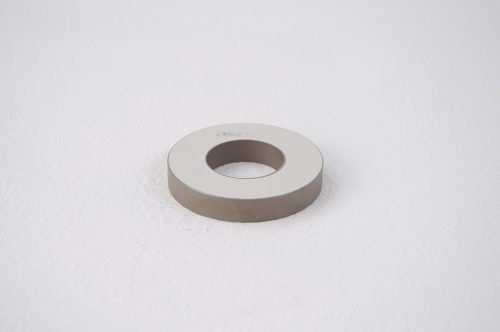
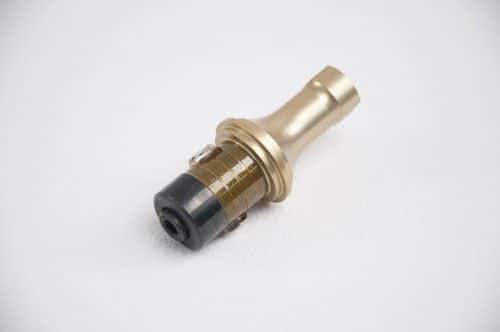
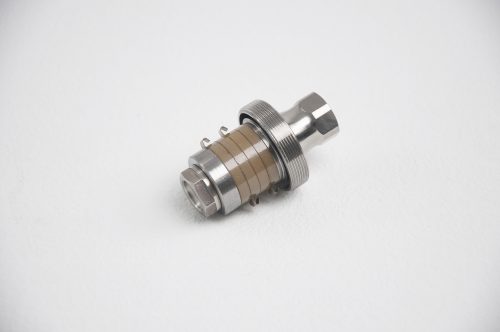
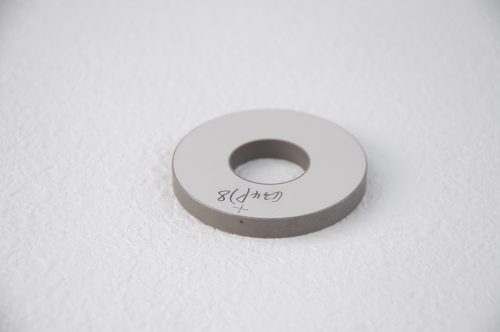
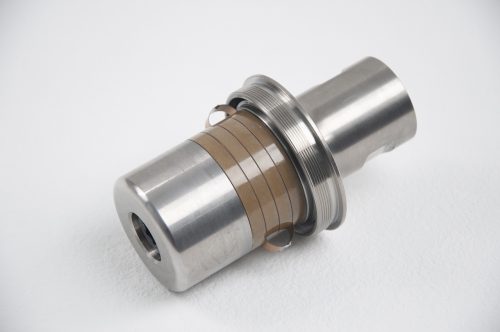
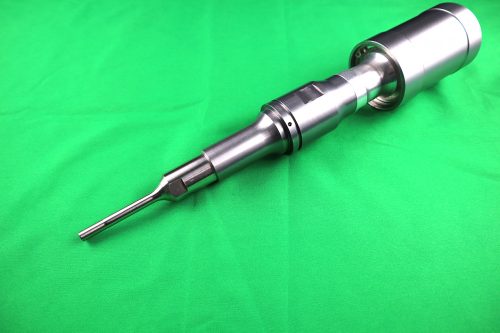
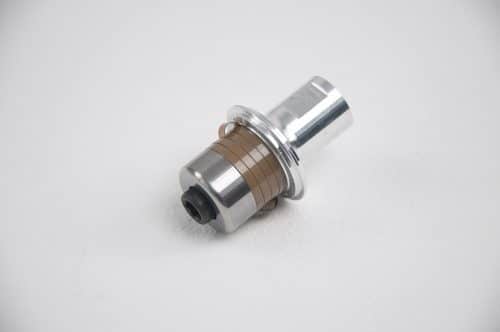
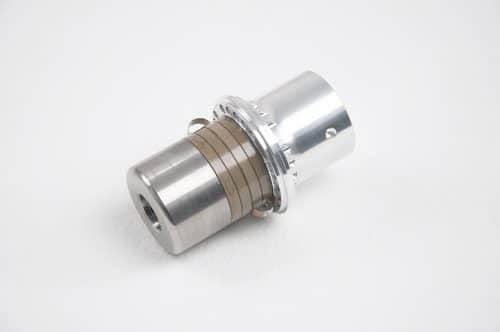
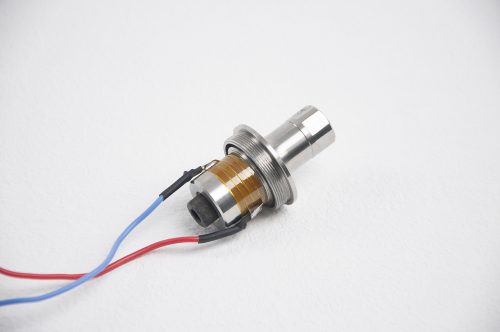
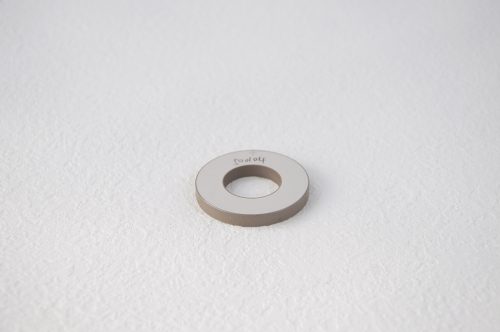
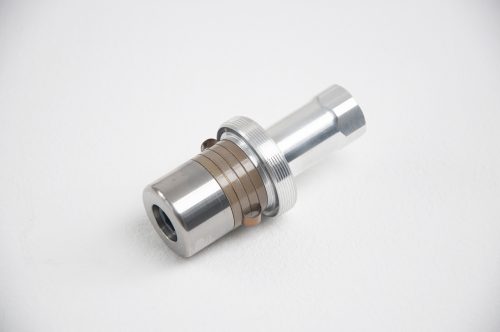
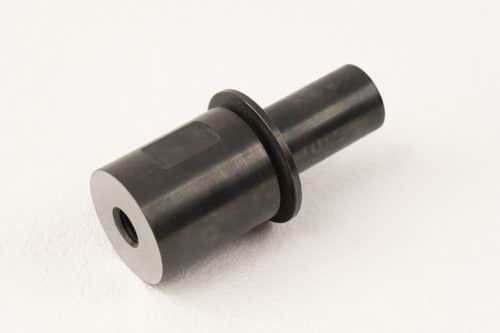
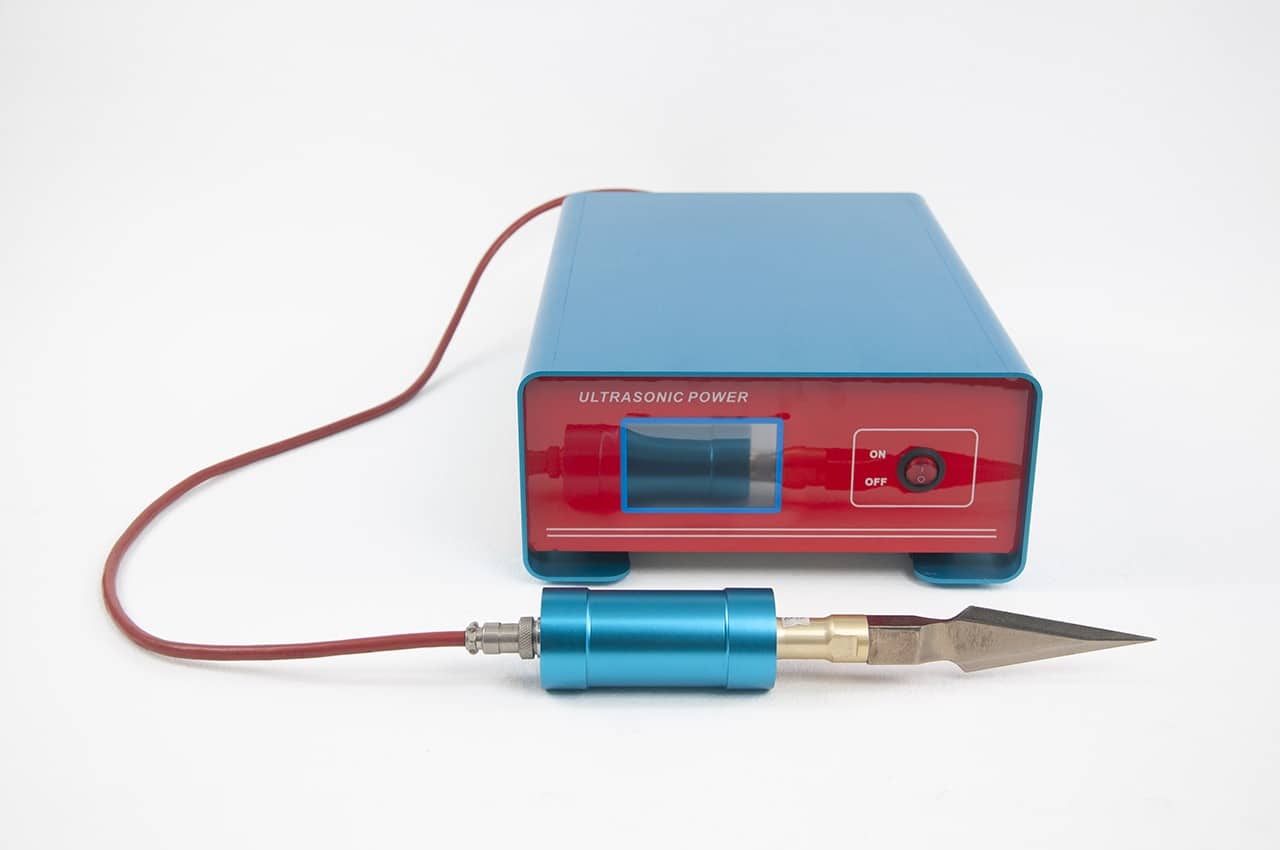
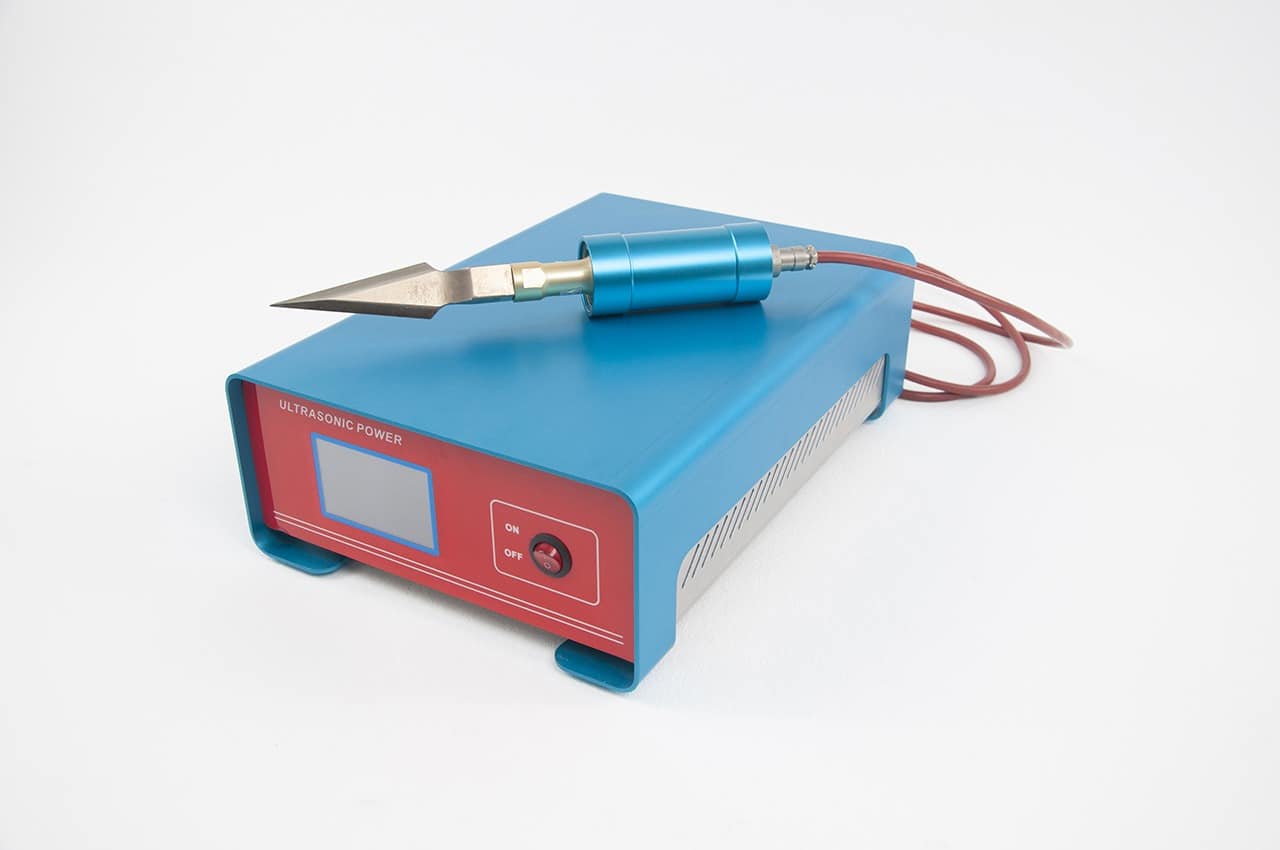
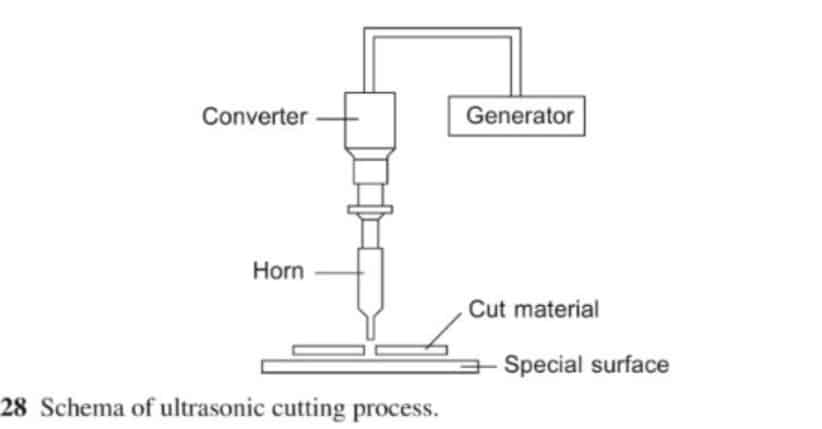
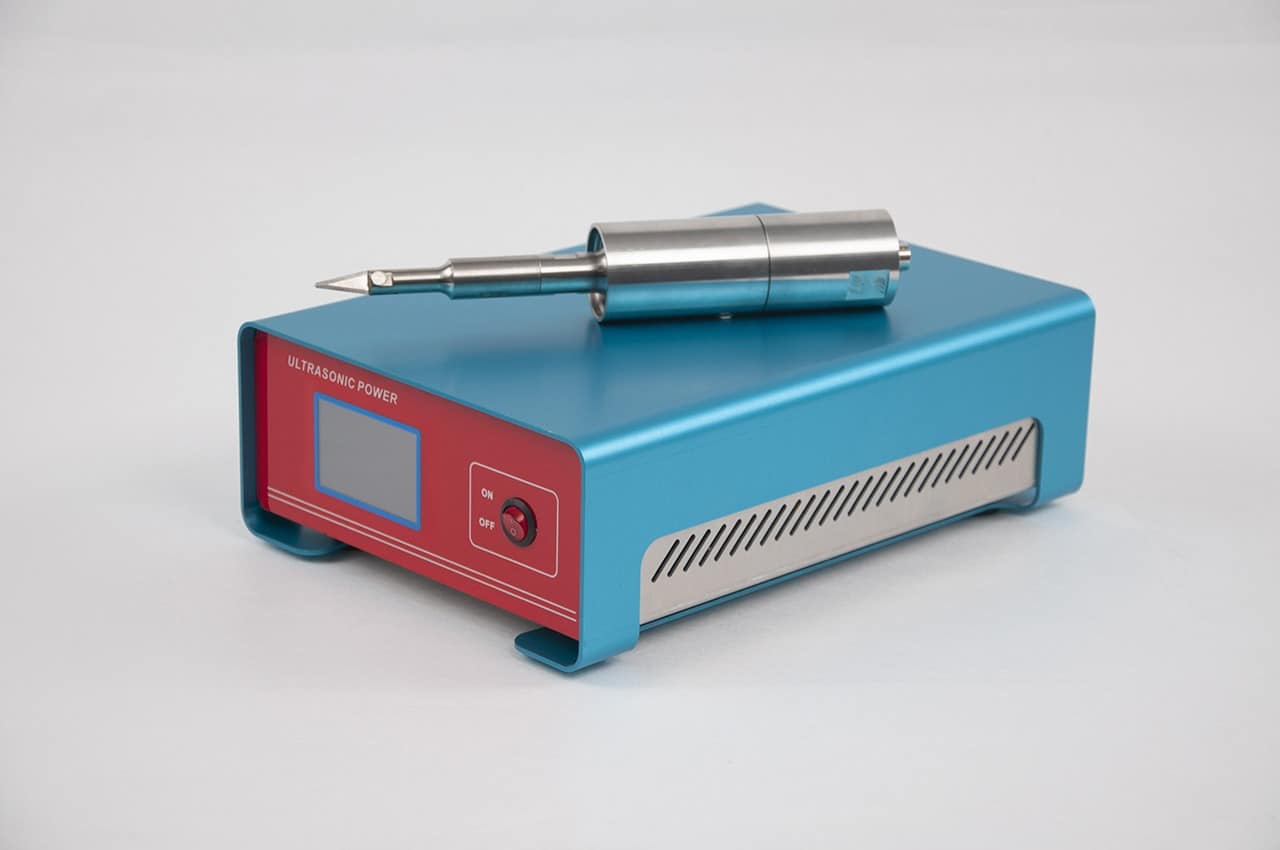
An ultrasonic cutter is a powered cutting tool that converts high-frequency electrical energy into mechanical vibration at the blade tip. A piezoelectric transducer generates the vibration; a titanium booster and blade amplify and transmit it to the cutting edge, which oscillates longitudinally at amplitudes typically in the range of 20 to 100 microns.
The result is a blade that vibrates thousands of times per second while it moves through the material. The friction between blade and workpiece drops dramatically compared to a stationary knife, which is why ultrasonic cutting is sometimes described as a “frictionless cut.” In practical terms, this means:
- Sticky or gel-like materials (layered cream cake, cheese, silicone) do not adhere to the blade.
- Elastic materials (rubber, neoprene, Kevlar) are cut rather than stretched and torn.
- Brittle materials (frozen food, carbon fiber composite panels) are parted cleanly without shattering.
- Layered or structured materials (honeycomb aluminum panels, sandwich composites) hold their geometry through the cut.
How Ultrasonic Cutting Works: The Physics in Plain Terms
Important: Ultrasonic cutters cannot cut solid aluminum plate or steel, but honeycomb aluminum panels can be cut successfully.
The high-frequency vibration creates a localized stress concentration at the blade edge. For thermoplastic materials — plastics, rubbers, nylons — this micro-scale friction generates just enough heat to momentarily soften a molecular-thin layer at the cut zone, reducing the force needed to part the material. For food products, the rapid oscillation breaks adhesion between the blade surface and the product without building up heat in the bulk food mass.
Three factors govern the outcome of an ultrasonic cut:
- Frequency — higher frequency (40 kHz) means finer vibration, suited to delicate or precision work. Lower frequency (20 kHz) puts more mechanical energy into the cut, needed for heavy industrial materials.
- Amplitude — the actual displacement of the blade tip. More amplitude means more cutting force; most systems let you set amplitude from 1% to 100% of maximum.
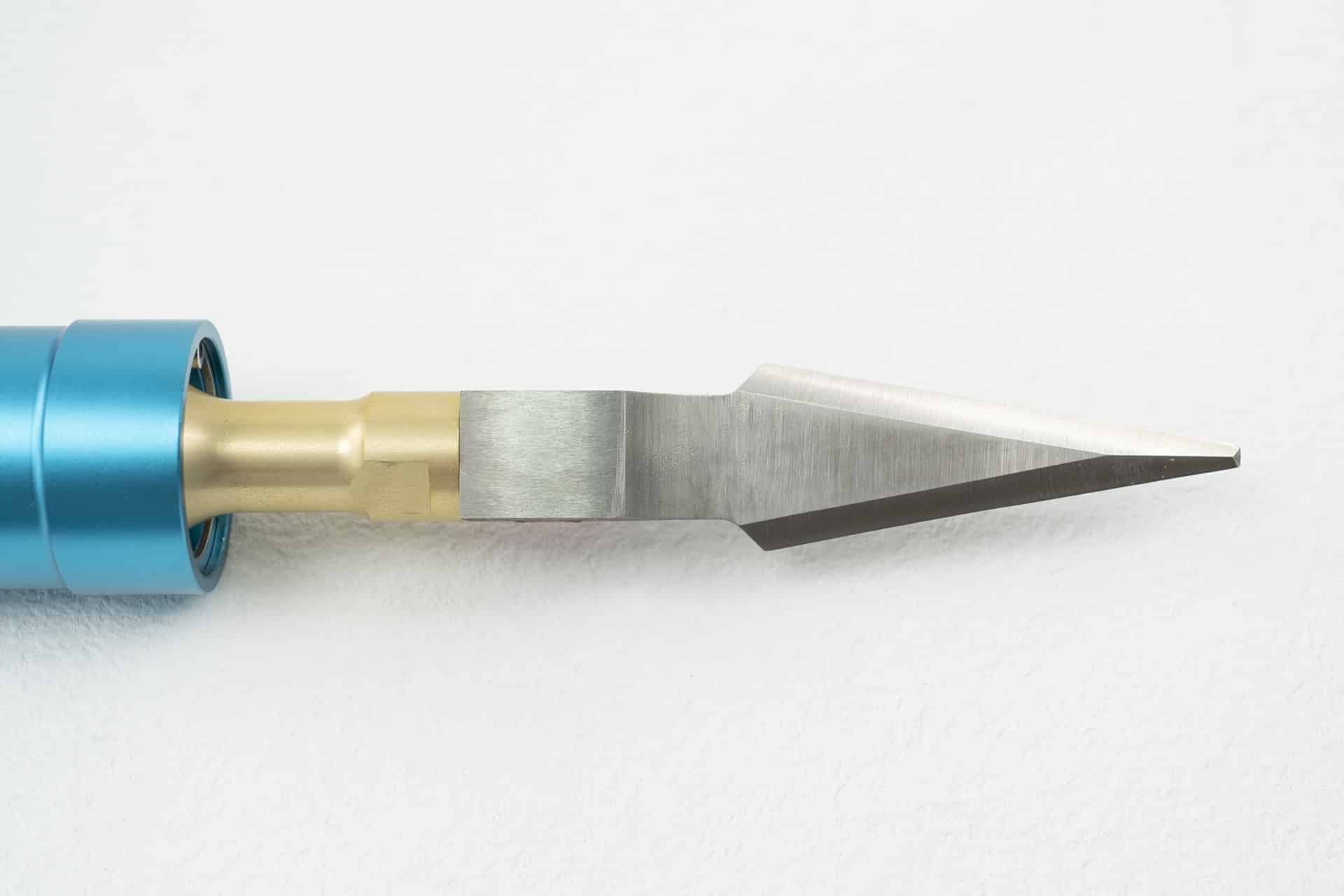
- Blade geometry — a straight blade for straight cuts on food lines; a rotary (cylindrical) blade for 3D profiling and robot-arm integration; a wide food blade (150–305 mm) for full-width cake cuts.
Ultrasonic Cutter Applications: Food and Industrial
Food Cutting
The food industry was one of the earliest industrial adopters of ultrasonic cutting, and for good reason. Cutting a multi-layer gateau with a conventional knife compresses the layers, smears the cream filling, and leaves crumbs across the cut face. An ultrasonic food cutter at 20 kHz glides through the same structure and leaves a mirror-smooth, geometrically perfect cross-section.
Typical food applications:
- Baked goods: Multi-layer cream cake, Swiss roll, brownie, tiramisu, Napoleon (mille-feuille), date cake, steamed sandwich cake. The ultrasonic blade slices through each cream and sponge layer without the layers sliding or the cream being squeezed out.
- Cheese and charcuterie: Hard and semi-hard cheeses, ham sandwiches. No sticking to the blade means consistent slice thickness and negligible product loss.
- Frozen food: The vibration is particularly effective on frozen products that would shatter under a standard blade. Frozen cakes, portioned meat blocks, and confectionery can all be cut in their frozen state, eliminating the defrost-then-cut cycle.
- Custom portioning shapes: Round, square, triangular, fan-shaped, or custom profiles are all achievable by programming the cutting path, opening up on-line portioning options that are impractical with rotary or guillotine blades.
The Sino Sonics SONOBIO food cutting blade runs at 20 kHz and is available in widths of 150 mm, 170 mm, 200 mm, 250 mm, and 305 mm to match standard food-line conveyor widths. Blade tips are machined from titanium alloy or finished with a Teflon non-stick coating depending on the product. The blade assembly (transducer plus booster) integrates directly into existing food-line frames — no rebuilding the line, just replacing the knife station.
Industrial Cutting — Rubber, Composites, Nonwovens, Plastics
Outside the food sector, ultrasonic cutting machines handle a broad range of materials that are difficult or costly to cut with conventional tooling:
Rubber and elastomers. Natural rubber, silicone, neoprene, and polyurethane present a classic problem: they deform under blade pressure and spring back, producing a ragged, inconsistent cut edge. Ultrasonic vibration parts the material cleanly without elastic recovery distorting the cut line. Deburring rubber moldings — removing flash lines after injection molding — is another high-volume application.
Composite materials and aerospace components. Carbon fiber reinforced polymer (CFRP), fiberglass resin panels, Kevlar laminates, and Nomex honeycomb cores are abrasive, delamination-prone, and structurally critical. Ultrasonic cutting at 30 kHz minimizes the lateral force on the cut face, dramatically reducing delamination risk compared to rotary saw or router methods. The blade tip reaches into curved or contoured surfaces that are inaccessible to standard tooling.
Nonwoven fabrics and technical textiles. Materials like Kevlar, high-tenacity nylon, and engineered nonwovens fray badly when cut with a standard blade or scissors. Ultrasonic energy seals the fiber ends at the moment of cutting, producing a clean, fray-free edge in a single pass. No secondary heat-sealing step is needed.
Plastics. ABS, PE, PVC, PC, acrylic, PP, and nylon sheet or film can all be trimmed with an ultrasonic knife. The cut is made without the heat build-up that causes melting or smearing with rotary saw blades, and without the mechanical stress that causes micro-cracking in brittle acrylics.
Honeycomb panels. Aluminum honeycomb (not solid aluminum plate) and paper/aramid honeycomb can be cut without cell collapse at the cut face — a significant quality advantage for aerospace and packaging applications.
Ultrasonic Cutter vs. Conventional Blade: Head-to-Head
| Parameter | Conventional Blade | Cortador ultrasónico |
|---|---|---|
| Blade-material friction | High | Very low (vibration reduces adhesion) |
| Deformation of elastic materials | Significant | Minimal |
| Sticking on food / sticky products | Common | Rare to none |
| Delamination risk on composites | Moderate to high | Low |
| Edge quality on nonwovens | Frays without secondary seal | Clean, sealed in one pass |
| Line integration | Standard | Standard (blade-station swap) |
| Blade replacement | Frequent (pressure causes wear) | Replaceable tips, 3–6 month service life |
| Noise level | Depends on material | Typically lower |
The one constraint of ult
Tip: Match cutting frequency to the material—lower kHz for heavy industrial work, higher kHz for precision and low-noise cuts.
rasonic cutting is that it is not suited to solid aluminum plate or steel. For anything softer — from frozen gateau to Kevlar composite panels — it is consistently the cleaner and often the faster option.
How to Choose an Ultrasonic Cutter: Frequency, Power, and Blade Type
Step 1: Match Frequency to the Material
- 20 kHz — Maximum mechanical energy per cycle. Choose this for heavy-duty industrial rubber cutting, frozen food lines, and honeycomb panels where you need cutting force more than fineness.
- 25 kHz — General-purpose industrial and laboratory. The standard Sino Sonics handheld cutter runs at 25 kHz and handles plastic sheeting, rubber, and lab-scale composites.
- 30 kHz — Best balance of speed and cut quality for composites, Kevlar, and technical textiles. The Sino Sonics rotary cutter operates at 30 kHz. Also the preferred frequency for robot-arm integration where vibration isolation of the arm is a concern.
- 40 kHz — Low-noise, precision applications. Less common in production cutting; used for fine detail cuts in thin films or delicate nonwovens.
Step 2: Select the Blade Configuration
Straight blade (standard / handheld). For straight-line cuts, edge trimming, and lab or workshop use. The Sino Sonics handheld 25 kHz model is the entry point and covers a wide range of materials.
Rotary blade. The Sino Sonics rotary cutter at 30 kHz features a 42 mm cylindrical body that mounts on robot arms, plotters, and multi-axis cutting heads. It allows 360-degree rotation for contour cutting — cutting complex 2D or 3D profiles on composite panels or technical fabrics without repositioning.
Wide food blade. For in-line food portioning, blade width (150–305 mm) is matched to the product width. Teflon coating is recommended for cream or gel-based products.
Integrated machine. If you need fully automated production — consistent cut depth, speed control, data logging, and hydraulic hold-down — an integrated ultrasonic cutting machine combines generator, transducer, blade, hydraulic lift, foot-pedal trigger, and built-in data logger in a single enclosure. Designed for shift-long continuous operation on a production line.
Step 3: Check Power
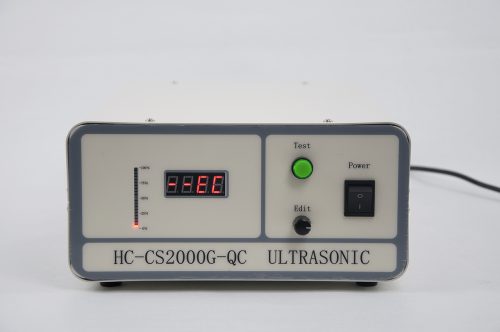
Sino Sonics ultrasonic cutters run from 600 W (standard configuration) to 1,200 W maximum on the rotary model, addressable in 1% steps. Most food-line applications run at 600–800 W. Heavy industrial rubber or composite cuts may use maximum amplitude at 1,200 W. The generator’s auto-resonance tracking circuit maintains the correct operating frequency as load changes during the cut — no manual tuning required.
Step 4: Handheld vs. Machine Integration
A handheld unit (or bench-top unit with a clamp stand) is the right starting point for:
- Application testing and prototyping
- Low-volume or variable-job workshops
- Field sampling
An integrated or automated configuration makes sense when:
- Cut consistency and repeatability across a shift is critical
- Throughput requires cuts faster than an operator can comfortably make manually
- Process data (cut count, amplitude log) is needed for quality records
What Sino Sonics Supplies
Sino Sonics (brand: SONOBIO) manufactures ultrasonic cutting systems at its factory in Wuxi, China. The current ultrasonic cutter product range includes:
- Handheld 25 kHz Ultrasonic Cutter — general industrial and lab plastic/rubber cutting
- Rotary 30 kHz Ultrasonic Cutter — 600 W standard / 1,200 W max, 4.7-inch touchscreen, 10 programmable presets, 360-degree mounting, suited for robot and plotter integration
- Food / Cake / Biscuit Ultrasonic Cutting Blade — 20 kHz, blade widths 150–305 mm, titanium or Teflon-coated tip, integrates into existing food-line frames
- Integrated Ultrasonic Cutting Machines — fully enclosed systems with hydraulic table, foot-pedal trigger, and production data logging
Every Sino Sonics ultrasonic cutting machine ships with a 1-year warranty. Before purchasing, customers can submit material samples for a free trial cut — the factory cuts the sample and returns it with a video of the process (typical turnaround: 10 days).
Frequently Asked Questions
Can an ultrasonic cutter handle frozen food without thawing first?
Yes. Frozen products that would shatter under a conventional blade respond well to ultrasonic cutting at 20 kHz. The vibration parts the material cleanly without the shock loading that causes fracture. This allows in-line portioning of frozen cakes, meat blocks, and confectionery without a defrost step.
What is the service life of an ultrasonic cutting blade?
Blade tips are consumables. Under normal production use, typical service life is 3–6 months. Sino Sonics keeps standard blade geometries in stock for quick replacement. The replaceable-tip design keeps changeover time short and lowers long-term tooling cost compared to replacing an entire assembly.
Can the rotary cutter be mounted on a robot arm?
Yes. The 42 mm cylindrical profile of the Sino Sonics rotary cutter is designed for mounting on industrial robot arms, CNC plotters, and multi-axis cutting heads. The 30 kHz operating frequency and the auto-resonance tracking circuit maintain stable output as the arm moves and the load angle changes.
Is the food cutting blade food-safe?
The blade is machined from titanium alloy. A Teflon (PTFE) non-stick coating is available for cream or sticky products. Both materials are widely used in food contact applications. For food-grade compliance documentation specific to your market or regulatory requirement, contact Sino Sonics directly.
What materials cannot be cut with an ultrasonic cutter?
Solid aluminum plate and steel are not suitable — the material is too hard for the blade to part via vibration. Honeycomb aluminum panels (where the aluminum is a thin-wall cell structure, not a solid mass) can be cut. Any material softer than metal is generally a candidate.
Get a Quote or Request a Free Trial Cut
Browse the full product range →
Tell us your material, cut dimension, and production volume — we will respond within one business day with a tailored recommendation and price.
Related posts
Popular products
-
 Anillo piezocerámico Φ69~Φ70mm
$20.00
Anillo piezocerámico Φ69~Φ70mm
$20.00
-
28kHz 600Watt F25-SA-1
Original price was: $220.00.$184.00Current price is: $184.00.
-
 SONOBIO 30L Ultrasonic Homogenizer Double-Layer Glass Reactor
Original price was: $10,000.00.$7,000.00Current price is: $7,000.00.
SONOBIO 30L Ultrasonic Homogenizer Double-Layer Glass Reactor
Original price was: $10,000.00.$7,000.00Current price is: $7,000.00.
-
15kHz 2600Watt Generador ultrasónico
Original price was: $960.00.$800.00Current price is: $800.00.
-
40kHz 800Watt F25ST1
Original price was: $250.00.$220.00Current price is: $220.00.
-
Anillo piezocerámico Φ55mm
Original price was: $14.00.$11.50Current price is: $11.50.
-
Anillo piezocerámico Φ38mm
Original price was: $6.00.$5.00Current price is: $5.00.
-
TelSonic Replacement 20kHz 3200Watt
Original price was: $390.00.$350.00Current price is: $350.00.
-
 20kHz 2000Watt Spot Welding Set
Original price was: $300.00.$260.00Current price is: $260.00.
20kHz 2000Watt Spot Welding Set
Original price was: $300.00.$260.00Current price is: $260.00.
-
35kHz 900Watt F30-SA-P
Original price was: $250.00.$207.00Current price is: $207.00.
-
TelSonic Replacement 20kHz 4500Watt
Original price was: $390.00.$350.00Current price is: $350.00.
-
Weber 35kHz 1200watt Replacement
Original price was: $280.00.$250.00Current price is: $250.00.
-
Anillo piezocerámico Φ45~Φ49mm
Price range: $5.00 through $9.50
-
28kHz 600Watt F30-SA-1
Original price was: $208.00.$184.00Current price is: $184.00.
-
20kHz Booster; Gain 1:3
Original price was: $180.00.$165.00Current price is: $165.00.