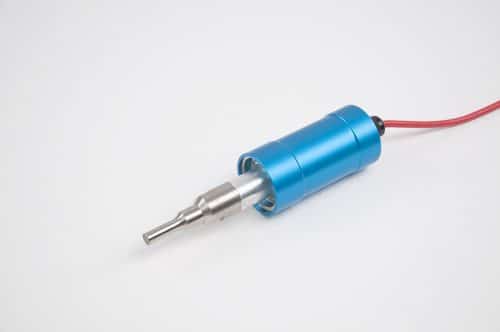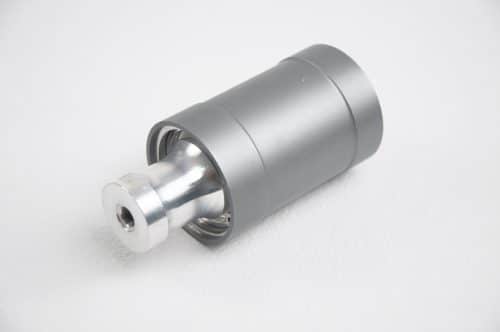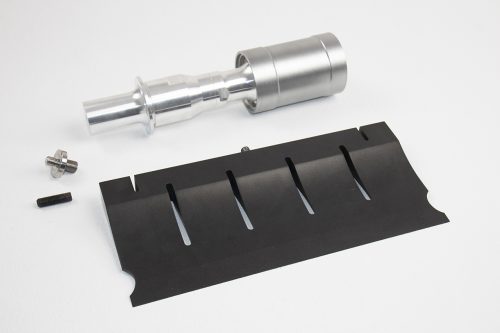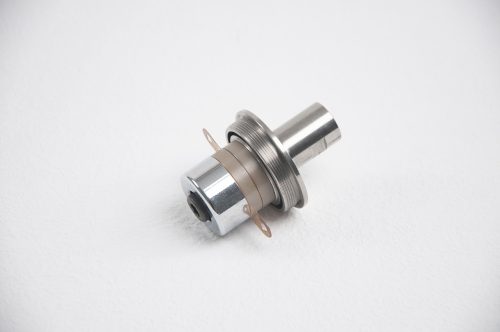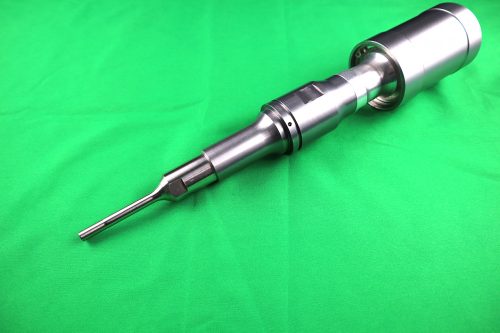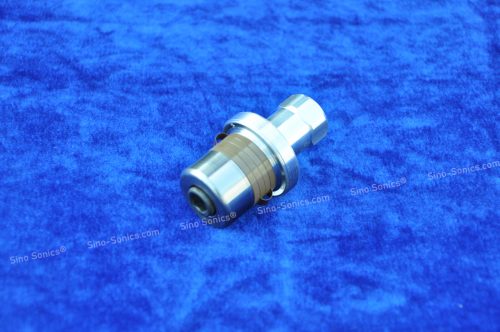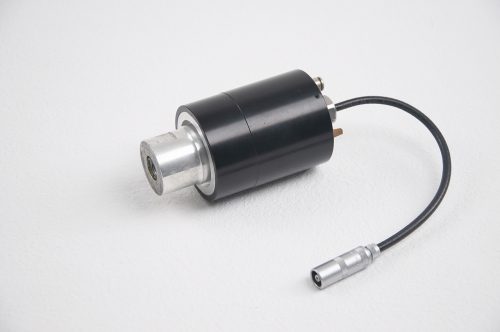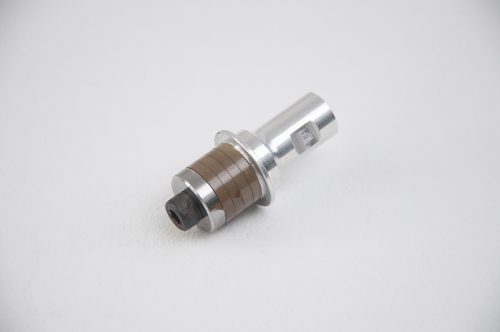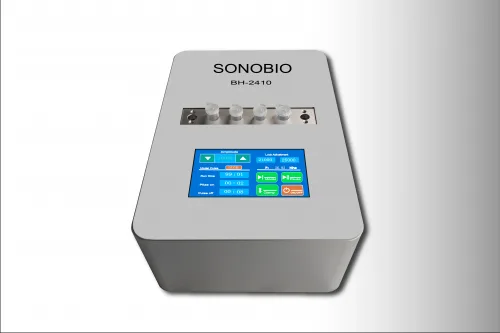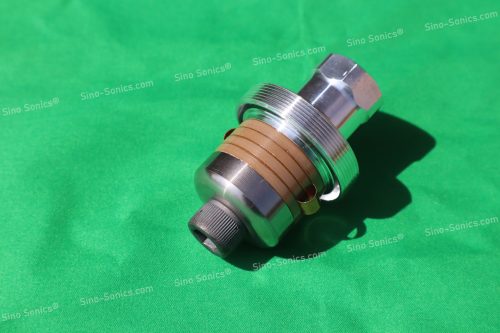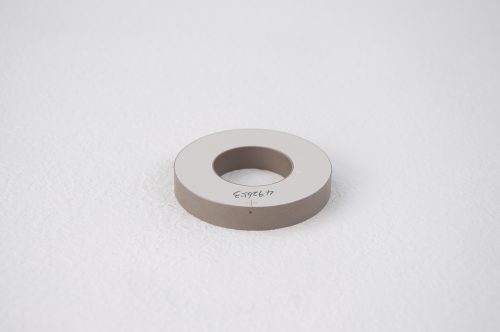

Qsonica (Q55, Q125, Q500, Q700, CL-334) and Sonics & Materials (Vibra-Cell VCX 130, VCX 500, VCX 750, GEX 750, GEX 1000) are among the most commonly used probe sonicators in life science, chemistry, and nanomaterials research. If you are looking for an alternative — whether to reduce cost, diversify your supply chain, or scale from lab to pilot — SONOBIO sonicators offer a comparable specification set at a direct-factory price point.
SONOBIO is the laboratory sonicator brand of Sino Sonics (Wuxi Hanwu Technology Co., Ltd., Wuxi, China), in operation since 2011 .
Key takeaways
- Amplitude in micrometers at the tip, not display watts, is the metric that matters for probe sonicators.
- SONOBIO spans four models: 0.3 mL-50 L volumes and 120 W-2000 W power.
- Qsonica Q500 and Sonics VCX 500 class systems list at $4,000-$6,000; SONOBIO prices well below.
- Probes use standard Langevin thread in 3, 6, 9, 12.7, 20, 25, 30 mm; not cross-compatible with other brands.
- Non-Contact model runs 8 sealed tubes in parallel for ChIP with zero cross-contamination.
Core Technology: What a Probe Sonicator Must Deliver
All probe sonicators — regardless of brand — work on the same principle: a piezoelectric transducer drives a titanium horn (probe) at ultrasonic frequency, creating cavitation in the liquid sample. The critical performance parameters are:
- Output amplitude (µm) at the probe tip — not display watts
- Frequency — standard is 20 kHz; some systems use 25 kHz for smaller bubble size
- Probe diameter — matched to sample volume
- Control resolution — pulse width, energy tracking, temperature monitoring
- Probe material — Grade 5 titanium (T1-6AL-4V) for chemical resistance and durability
SONOBIO covers all these parameters with four models spanning 0.3 mL to 50 L and 120 W to 2000 W.
How SONOBIO Compares — Approximate Cross-Reference
| Common Use Case | Qsonica Reference | Sonics & Materials Reference | SONOBIO Alternative |
|---|---|---|---|
| Small samples, portable | Q55, Q125 | Vibra-Cell VCX 130 | SONOBIO Handheld (20 kHz, 120 W, 0.3–500 mL) |
| Mid-power lab benchtop | Q500 | Vibra-Cell VCX 500 | SONOBIO Integrated (25 kHz, 800 W, 0.5 mL–3 L) |
| High-power lab / pilot | Q700, CL-334 | VCX 750, GEX 750, GEX 1000 | SONOBIO Split (20 kHz, 1200–2000 W, 0.2 mL–5 L) |
| Industrial / large batch | — | — | SONOBIO Industrial (20 kHz, 2000 W, up to 50 L, 24×7) |
Note: Qsonica and Sonics & Materials model names are cited for comparison purposes only. SONOBIO is an independent product line with no affiliation to either company.
SONOBIO Model Details
Handheld (120 W, 20 kHz)
Eight-level power control, one-button start. Weighs under 1 kg. Handles 0.3 mL microtubes through 500 mL beakers. Probe is Grade 5 titanium, Φ6 mm standard. Also usable as a spot welder for small assembly jobs. Best for routine sample prep tasks that do not require logged energy data.
Integrated Benchtop (800 W, 25 kHz)
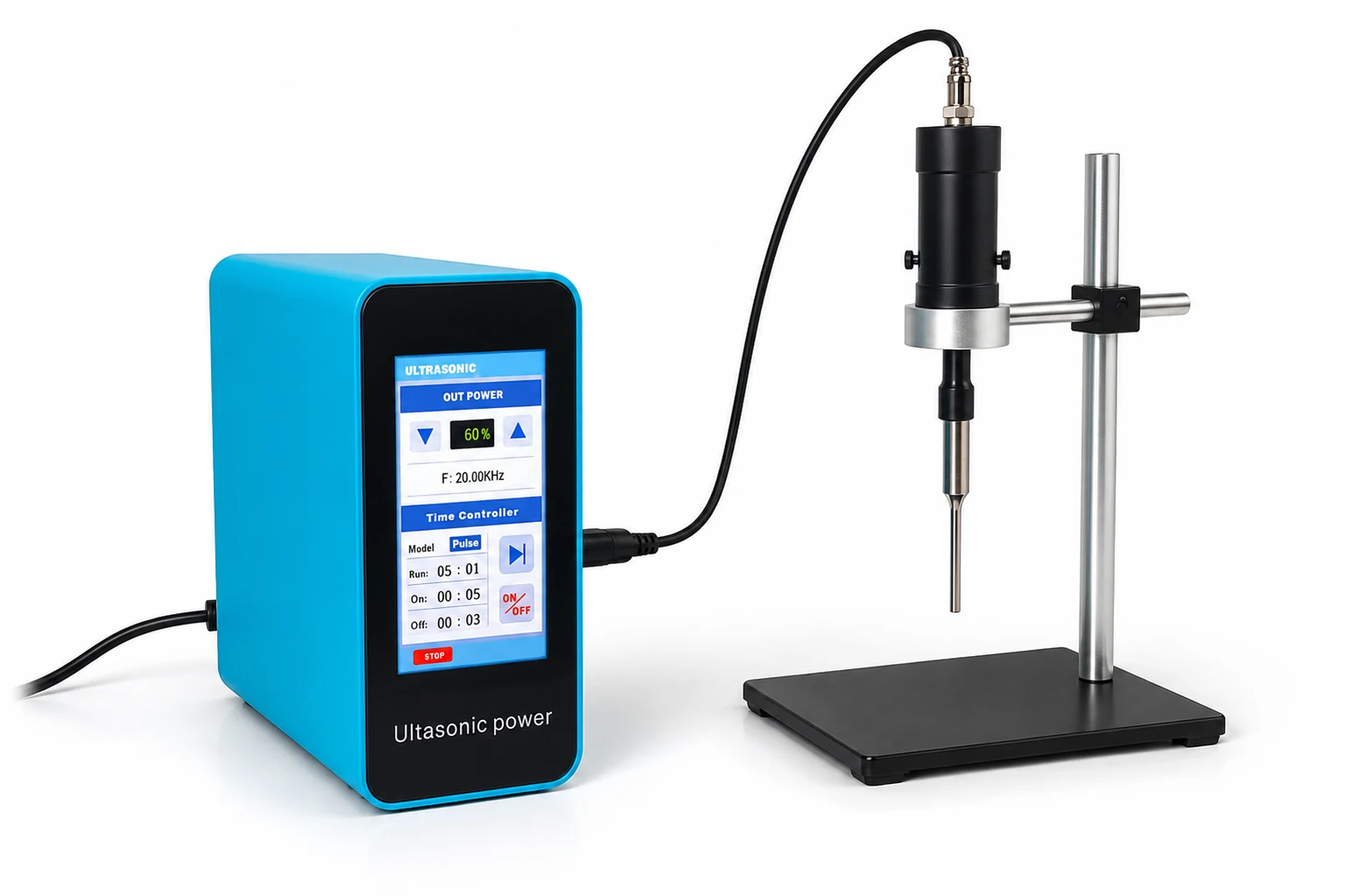
The standout feature is the built-in soundproof enclosure with a glass observation window — you can watch processing without hearing protection. The 4.7-inch color touchscreen displays real-time power (W), cumulative energy (J), elapsed time, and sample temperature (when probe is fitted). Up to five sequential process programs can be stored. Automatic temperature-based shutdown prevents heat-sensitive samples from denaturing. Supports probes Φ3–30 mm; amplitude up to 100 µm.
This model is the direct competitor to the Q500 for reproducible mid-throughput lab work.
Split Type (1200–2000 W, 20 kHz, 7-inch Touchscreen)
Generator and probe head are separate, allowing the probe to be positioned inside a biosafety cabinet or fume hood while the generator sits on a bench. Auto-sweep frequency tracking (19–26 kHz) maintains resonance as sample load shifts. Three run modes: continuous, timed pulse (on/off ratio adjustable), and interval. Simultaneous display of time, power, energy, and temperature.
The 2000 W configuration with Φ25–30 mm probes addresses the high-amplitude end that Sonics & Materials GEX 1000 users often need for dense dispersions or viscous emulsions.
Sample volume: 0.2 mL (microtip) to 5 L.
Probe temperature rating: up to 600 °C (1112 °F) — fully compatible with high-temperature process chemistry.
Industrial (2000 W real, up to 50 L, 24×7)
Standard probe Φ40 mm × 290 mm. Optional flow-through cell for continuous inline processing — suitable for scale-up of emulsification, nanomaterial dispersion, or sonochemical reactions. Fan cooling on both transducer and generator for continuous-duty operation. Digital wattmeter, auto-tuning generator.
Why Labs and OEM Integrators Switch to SONOBIO
Lower Acquisition Cost
Qsonica Q500 and Sonics VCX 500 class systems typically list at $4,000–$6,000 in the US market through distributors. SONOBIO Integrated and Split models are priced substantially below that — contact us for a side-by-side quote. For institutions managing tight capital equipment budgets, the delta is material.
Direct Probe Replacement Supply
Probes are the highest-wear item in any sonicator. SONOBIO probes follow standard Langevin thread sizing, and replacement probes are available individually in Φ3, 6, 9, 12.7, 20, 25, and 30 mm diameters and custom lengths. You are not locked into a single vendor for consumables.
Protocol Compatibility
Tip: Transfer protocols between sonicator brands by matching cumulative acoustic energy per mL (J/mL), not amplitude percent.
If your existing SOP specifies amplitude (µm) or energy (J/mL), SONOBIO’s calibrated amplitude display and real-time joule counter let you replicate the same energy delivery on a different instrument — which is the correct way to transfer a sonication protocol between sonicator brands.
ChIP and Genomics Workflows
For chromatin shearing (ChIP-Seq), the SONOBIO Non-Contact sonicator offers 8 sealed-tube parallel processing with no probe insertion — zero cross-contamination and lower aerosol risk. This addresses a gap that both Qsonica and Sonics & Materials fill with Cup Horn accessories. The SONOBIO Non-Contact is a standalone instrument purpose-built for this workflow.
OEM Integration
R&D equipment builders can purchase generator boards, transducers, and probe heads separately for integration into custom instruments. Contact us for OEM pricing and minimum order quantities.
Frequently Asked Questions
Are SONOBIO probes interchangeable with Qsonica or Sonics & Materials probes?
SONOBIO probes use a standard Langevin stud thread. They are not dimensionally identical to Qsonica or Sonics proprietary probe threads and are not cross-compatible. SONOBIO probes are designed for use with SONOBIO transducers and boosters.
My current Qsonica protocol calls for a specific amplitude setting in percent. How do I transfer that to SONOBIO?
Amplitude percentages are instrument-specific — 40% on a Q700 is not the same absolute amplitude as 40% on another brand. The correct transfer method is to match the cumulative acoustic energy delivered per mL of sample (J/mL). SONOBIO’s energy display makes this straightforward. We can provide a brief application note on protocol transfer on request.
Do you have a microtip for processing samples below 1 mL?
Yes. The Split model supports a Φ3 mm microtip for volumes down to 0.2 mL (in a microcentrifuge tube with appropriate adapter). The Integrated model supports Φ3 mm as well, with the advantage of the built-in enclosure minimizing aerosol exposure for small-volume samples.
Do you support ChIP assay workflows?
Yes. For ChIP, the SONOBIO Non-Contact model is the recommended unit — 8 sealed tubes processed in parallel, no cross-contamination, lower aerosol generation. For single-sample ChIP using a probe, the Split model with pulse mode and temperature monitoring is appropriate.
Is there a warranty on the instrument?
Complete sonicator systems (generator + transducer + housing) carry a 1-year manufacturer’s warranty. Probes are consumable items whose service life depends on operating conditions; they are not covered under the instrument warranty.
Get a Quote
Browse the full product range →
Tell us your application, sample volume, and whether you need batch or continuous processing. We will recommend the right SONOBIO model and reply with a proforma invoice within one business day.
*See also: All Ultrasonic Transducers · Piezoelectric Ceramic Rings*
Related posts


Popular products
-
 35kHz 300Watt-D30-SA
Original price was: $220.00.$170.00Current price is: $170.00.
35kHz 300Watt-D30-SA
Original price was: $220.00.$170.00Current price is: $170.00.
-
Impedance Analyzer PV520A-T (1KHz~3MHz)
Original price was: $3,200.00.$2,750.00Current price is: $2,750.00.
-
35kHz 1000Watt F30-ST-1
Original price was: $280.00.$220.00Current price is: $220.00.
-
20kHz 1200Watt Branson 900 Replacement
Original price was: $300.00.$260.00Current price is: $260.00.
-
35kHz 900Watt Spot Welding Set
Original price was: $240.00.$200.00Current price is: $200.00.
-
20kHz 2000Watt Transducer (Aluminum Housing)
Original price was: $360.00.$330.00Current price is: $330.00.
-
 Ultrasonic Food(Cake,biscuit)Cutter/Cutting Machine/Blade
Price range: $1,500.00 through $1,700.00
Ultrasonic Food(Cake,biscuit)Cutter/Cutting Machine/Blade
Price range: $1,500.00 through $1,700.00
-
SoniKKs 35kHz 1200watt Replacement
Original price was: $280.00.$250.00Current price is: $250.00.
-
20kHz 2000Watt Spot Welding Set
Original price was: $300.00.$260.00Current price is: $260.00.
-
35kHz 900Watt 35FA915-1
Original price was: $250.00.$207.00Current price is: $207.00.
-
Telsonic 36kHz 1000watt Replacement
Original price was: $580.00.$550.00Current price is: $550.00.
-
35kHz 800Watt F25-SA-1
Original price was: $240.00.$207.00Current price is: $207.00.
-
SONOBIO Non-Contact 4 Channel Ultrasonic Homogenizer/ Sonicator
Original price was: $4,000.00.$2,599.00Current price is: $2,599.00.
-
40kHz 900Watt F30SA1
Original price was: $250.00.$220.00Current price is: $220.00.
-
Piezo Ceramic Ring Φ60mm
Original price was: $17.00.$15.50Current price is: $15.50.