Every ultrasonic system — whether it welds plastic housings, homogenizes pharmaceutical emulsions, or drives a vibrating screen in a mining plant — starts with one critical component: the transducer. Get the transducer wrong and the system underperforms, overheats, or fails early. Get it right and it runs reliably for years.
This guide walks through the four decisions that matter most when selecting an ultrasonic transducer: frequency, power rating, mounting configuration, and thermal management. It is written for engineers specifying new systems and for procurement teams replacing existing units.
Key takeaways
- Choose frequency by application: lower kHz gives more energy, higher kHz finer vibration.
- Match OEM power rating or step up one tier; add 25–50% margin for continuous duty.
- Use fan-cooled units when duty cycle exceeds 70% or ambient exceeds 35 °C.
- Sino Sonics offers 46+ models spanning 15–40 kHz and 300–4,500 W.
- Drop-in replacements cover Branson, Telsonic, Herrmann, Dukane, and SoniKKs.
- Verify stack tuning to within ±50 Hz with an impedance analyzer before installation.
What an Ultrasonic Transducer Does
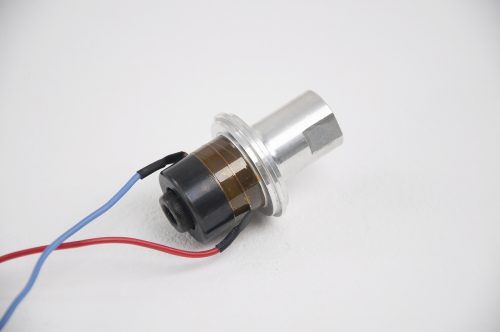
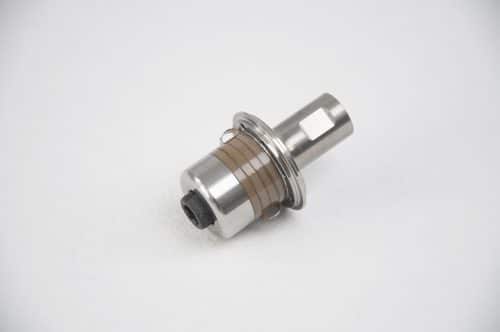
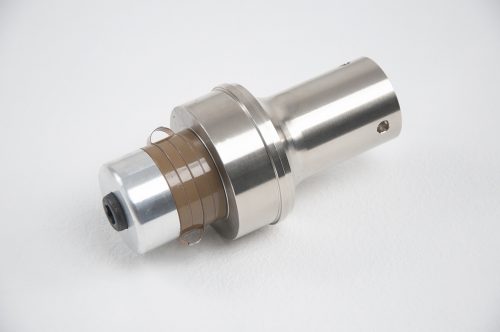
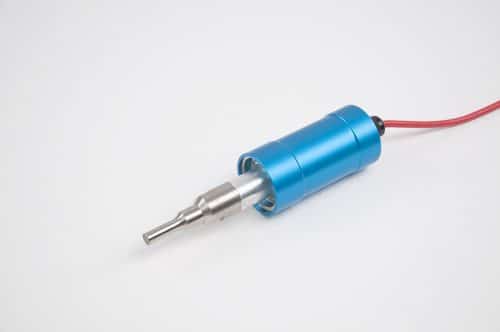
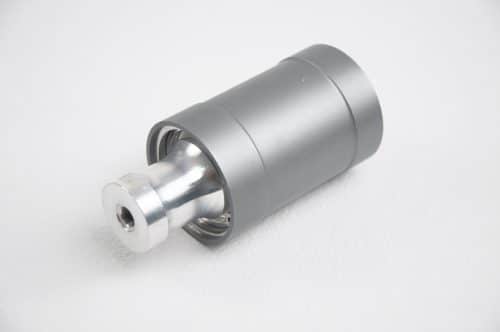
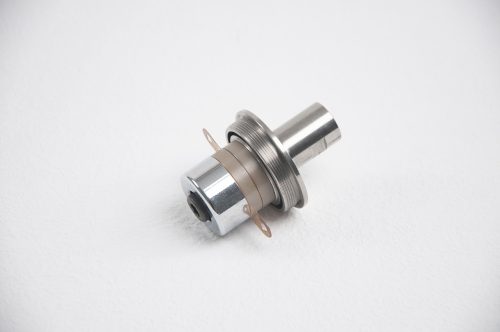
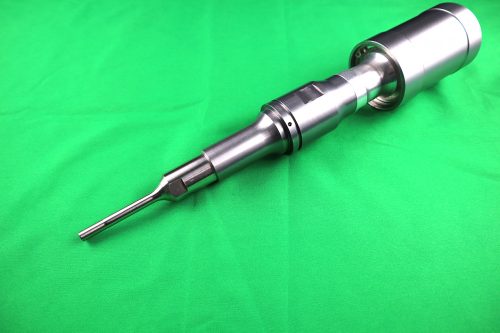
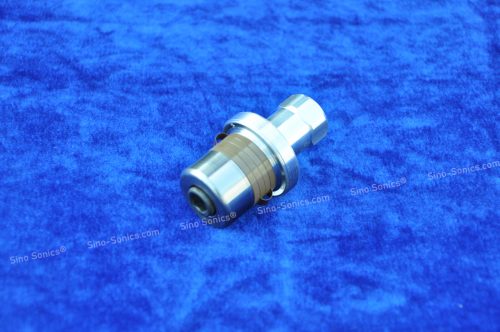
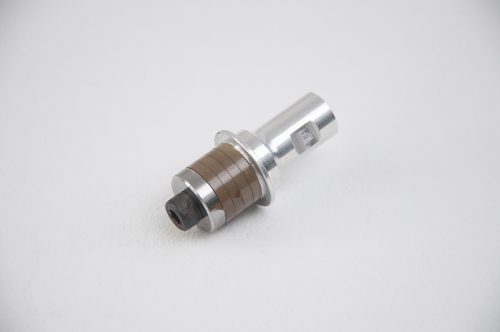
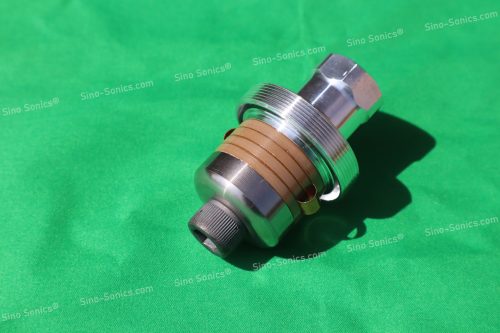
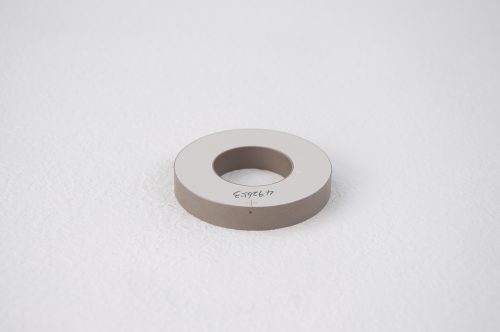
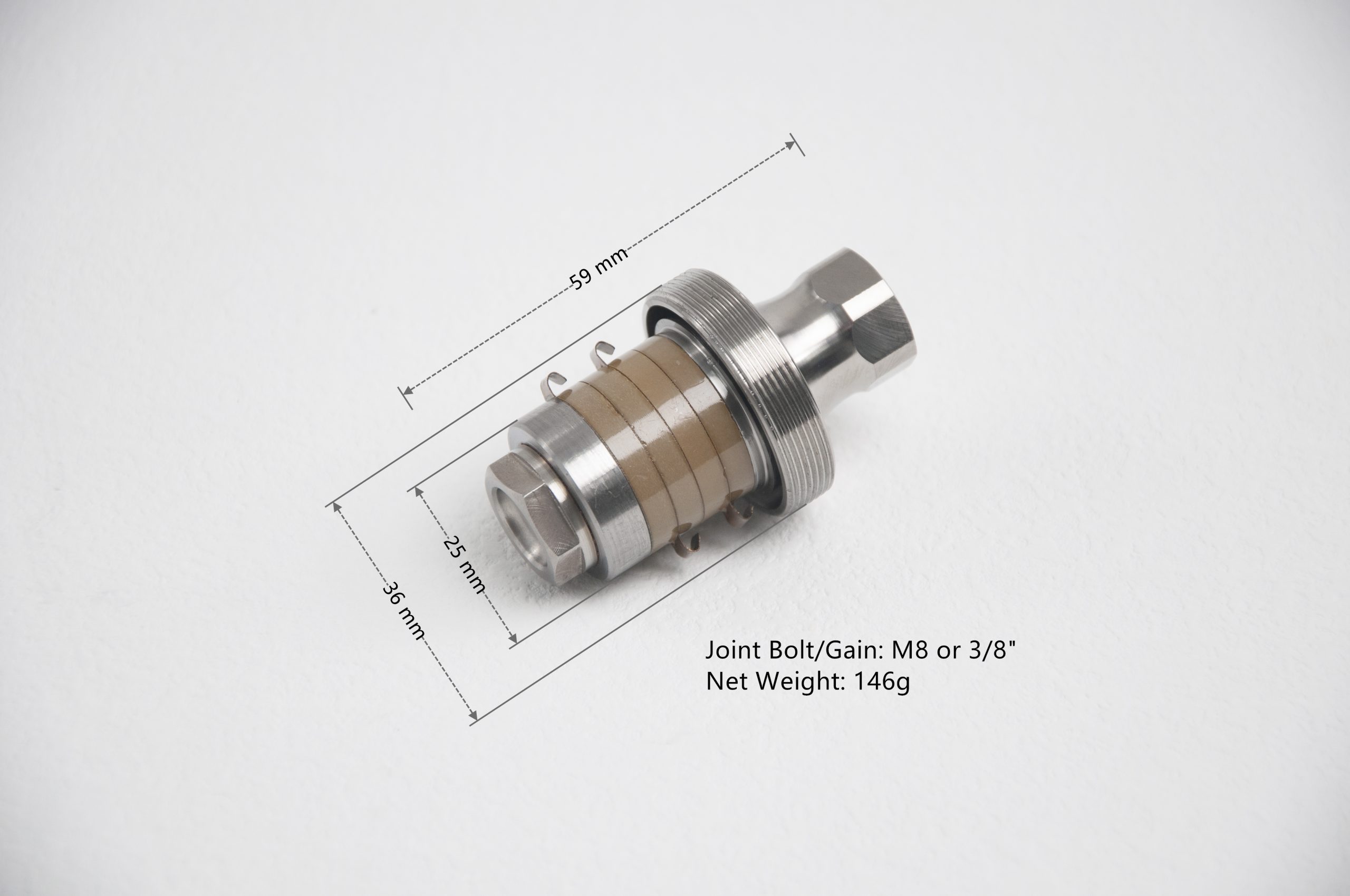
An ultrasonic transducer (also called a converter) is the electromechanical interface between the generator and the mechanical load. The generator produces a high-frequency AC signal — typically 15 kHz to 40 kHz — and the transducer converts that electrical energy into longitudinal mechanical vibration using a stack of piezoelectric ceramic rings clamped between two metal end-masses by a central bolt.
This bolt-clamped Langevin construction is the industry standard for high-power ultrasonics. The piezoelectric stack (typically PZT-8 for continuous-duty applications) sits under pre-compression from the bolt, which allows it to handle the high cyclic tensile and compressive stresses of continuous operation without cracking.
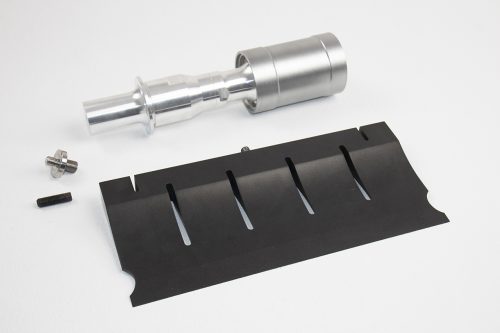
The transducer output — vibration amplitude at its front face — connects via a booster to a sonotrode or probe. Amplitude is where the actual process work happens: welding, cutting, emulsification, or sieving.
Step 1: Match Frequency to the Application
Frequency is the most consequential spec to get right. It cannot be changed after purchase — the transducer, booster, and sonotrode must all be tuned to the same frequency.
| Frequency | Typical Applications | Notes |
|---|---|---|
| 15 kHz | Heavy-duty plastic welding (thick parts), large-area welding | Highest energy per cycle; largest transducer footprint |
| 20 kHz | Industrial plastic welding (main workhorse), rubber cutting, homogenizers, cleaning | Dominant frequency across all sectors; widest support ecosystem |
| 28 kHz | Cleaning tanks, specialty welding | Quieter than 20 kHz; good balance of energy and resolution |
| 30 kHz | Precision welding, rotary cutting, homogenizers | Common in cutting tools and mid-power lab processors |
| 35 kHz | Fine plastic welding (fragile parts, thin walls), European welding standards | Standard for Herrmann, Telsonic, Weber, SoniKKs systems |
| 40 kHz | High-frequency cleaning, precision welding, thin-film cutting | Finest vibration; lowest amplitude; quietest operation |
Rule of thumb: lower frequency delivers more mechanical energy per cycle — useful when you need cutting or welding force. Higher frequency produces finer vibration — useful when delicate parts or precision work demands lower impact.
For vibrating-screen applications (sieving, powder separation), 20 kHz and 28 kHz are both common. The transducer drives the screen frame or the mesh directly, breaking mesh blinding and increasing throughput.
Step 2: Select the Right Power Rating
Warning: Exceeding rated power heats the ceramic stack, causes frequency drift, and can permanently depole the transducer.
Power rating governs how much mechanical work the transducer can sustain continuously without overheating. Exceeding the rated power causes the ceramic stack to heat up, leading to frequency drift and, eventually, depoling — irreversible loss of piezoelectric activity.
Sino Sonics ultrasonic transducers span 300 W to 4,000 W per unit. General guidance:
| Power Range | Suitable For |
|---|---|
| 300–600 W | Precision plastic welding (small components), thin-wall welding, lab homogenizers |
| 600–1,200 W | Standard industrial welding, mid-scale homogenizers, rotary cutting |
| 1,200–2,000 W | Heavy-duty welding (thick ABS / PP), continuous food-line cutting |
| 2,000–3,600 W | Large-area welding, high-volume cleaning systems, vibrating screens |
| 3,600–4,500 W | Very large welding assemblies, demanding industrial continuous processes |
If a process runs intermittently (duty cycle below 50%), you can often use a lower power class. Continuous processes — welding machines running 16-hour shifts, homogenizers processing batch after batch — should be specified at the higher end to give thermal headroom.
For replacement units, match the OEM power rating exactly or step up by one tier. Stepping down risks premature failure; stepping up is generally harmless if the generator can match the power.
Step 3: Choose the Mounting Configuration
Mounting requirements differ substantially by application type:
Standard Bolt-Clamped Langevin (Welding and Homogenizing)
The most common configuration. A threaded stud on the transducer front face connects to the booster, and the booster connects to the sonotrode. The assembly is clamped into a pneumatic or servo press. This is the configuration used in virtually all ultrasonic plastic welders and lab/industrial homogenizers.
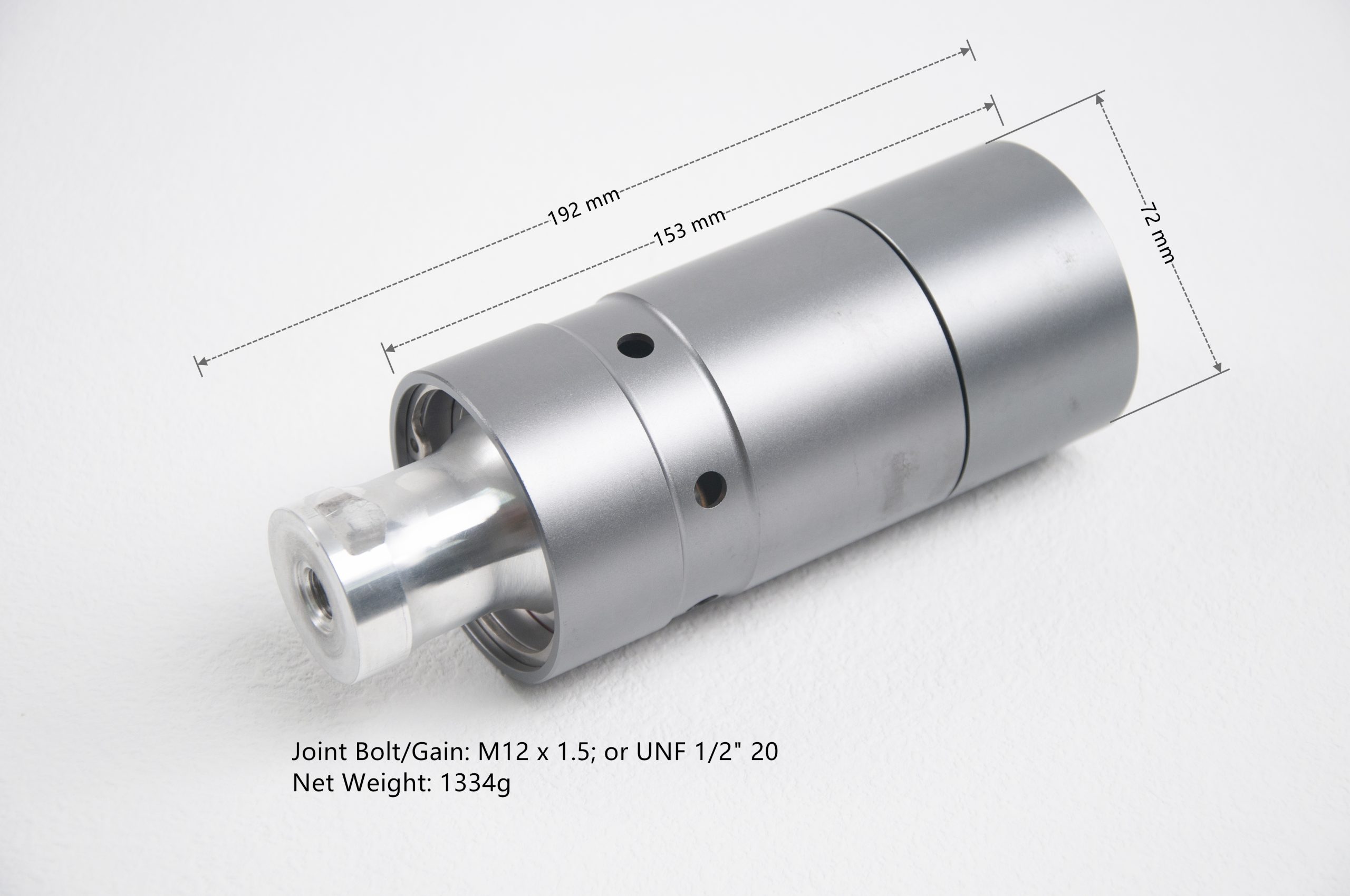
Key dimensional specs to match: front face thread size and pitch (M10, M16, or customer-specific), stud length, body outer diameter (typically 50–78 mm), and overall length.
Vibrating Screen Transducers
Vibrating screens use transducers bonded or bolted directly to the screen frame — not stacked with a booster and sonotrode. These require a flat-mount or side-mount configuration and are typically selected in the 20–28 kHz range. The transducer drives the entire screen at resonance, preventing mesh blinding and helping fine powders pass through efficiently.
Fan-Cooled Transducers
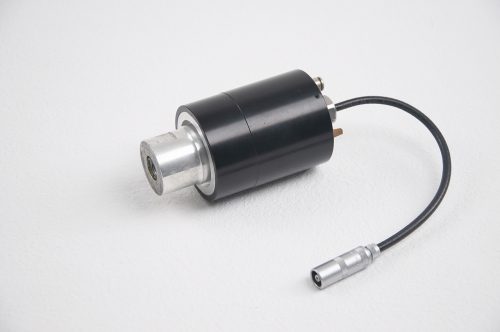
For continuous-duty applications at high power and ambient temperatures above 35 °C, fan cooling extends operating life significantly. The integrated cooling fan maintains the ceramic stack below its thermal limit even under prolonged loading. Sino Sonics offers fan-cooled models in the 20 kHz / 2,000 W+ range. Specify fan cooling whenever the duty cycle exceeds 70% or the environment is hot.
Brand-Compatible Replacement Units
If you are replacing a transducer in an existing Branson, Telsonic, Herrmann, Dukane, or SoniKKs welding machine, the critical specs are:
- Frequency and power (must match the generator output)
- Front-face thread and booster interface (must be dimensionally compatible)
- Body diameter and overall length (must clear the press housing)
Sino Sonics manufactures drop-in compatible replacements for the most common European and American welding platforms:
| OEM System | Frequency / Power | Sino Sonics Replacement |
|---|---|---|
| Branson 900 series (900M / 900MA / 900IW) | 20 kHz / 1,200 W | Available |
| Branson 803 / 8700 | 20 kHz / 2,000 W | Available |
| Branson 922 / CJ-20 / CR-20 | 20 kHz / 3,600 W | Available |
| Branson D30ST (cleaning) | 40 kHz / 600 W | Available |
| Telsonic SG-22 / SG-36 | 36 kHz / 1,000 W | Available |
| Telsonic (mid-power) | 20 kHz / 3,200 W | Available |
| Telsonic SG/MPI (high-power) | 20 kHz / 4,500 W | Available |
| Telsonic SG-35 / TG-35 | 35 kHz / 1,200 W | Available |
| Herrmann KHS-35 / Dialog-35 | 35 kHz / 1,200 W | Available |
| SoniKKs 35 kHz standard | 35 kHz / 1,200 W | Available |
| Dukane iQ / 41C28 series | 20 kHz / 2,000 W | Available |
Tip: the 35 kHz / 1,200 W interface is largely cross-compatible across Telsonic, Herrmann, Weber, and SoniKKs platforms — one Sino Sonics replacement unit covers four brands.
Step 4: Consider Thermal Management
Important: Keep the ceramic below its ~320 °C Curie point; heat raises losses, destabilizes amplitude, and accelerates aging.
Heat is the primary cause of premature transducer failure. The piezoelectric ceramic stack operates correctly only below its Curie temperature (around 320 °C for PZT-8, much lower for PZT-4). Long before the Curie point, elevated temperature raises internal losses, causes amplitude instability, and accelerates aging.
Three factors increase thermal load:
- High duty cycle — continuous or near-continuous operation
- High power — especially at maximum amplitude
- Poor acoustic contact — a mis-tuned booster or damaged sonotrode reflects energy back into the transducer as heat
Mitigation:
- Match power rating generously (do not operate at 100% amplitude continuously)
- Use fan-cooled models for 24/7 applications
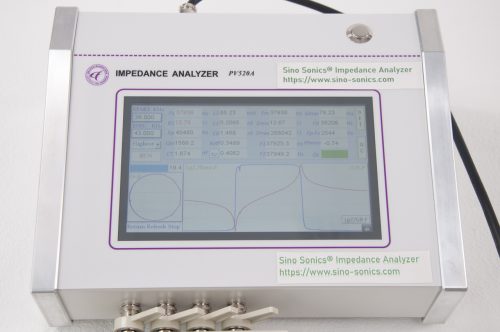
- Verify the stack-up — transducer, booster, and sonotrode should be tuned to match within ±50 Hz if possible; use an impedance analyzer to confirm before installation
- Allow cooldown between batches if the duty cycle is variable
Transducer Selection Summary Table
| Parameter | Decision |
|---|---|
| Application type | Welding → 20 or 35 kHz; cleaning → 28 or 40 kHz; cutting → 20 or 30 kHz; sieving → 20 or 28 kHz; homogenizing → 20 or 30 kHz |
| Power | Match OEM rating; add 25–50% margin for continuous duty |
| Mounting | Bolt-clamp Langevin for welding/homogenizing; flat-mount or bonded for screens |
| Thermal | Fan cooling if duty cycle > 70% or ambient > 35 °C |
| Replacement | Match frequency, power, and front-face thread; Sino Sonics covers Branson, Telsonic, Herrmann, Dukane, SoniKKs |
What Sino Sonics Offers
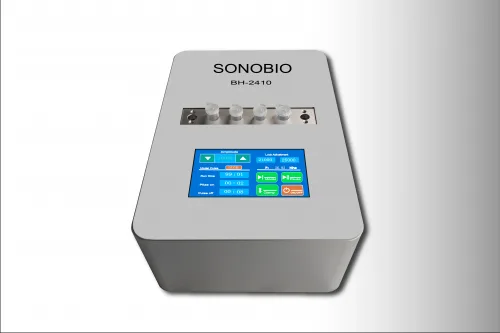
Sino Sonics (brand: SONOBIO) manufactures and stocks 46+ ultrasonic transducer models spanning 15 kHz to 40 kHz and 300 W to 4,500 W. The range includes:
- Own-brand standard units — F30-SA, F50-SA, K50-SA, D30-SA, 35FA915 and others; 15 / 20 / 25 / 28 / 30 / 35 / 40 kHz
- Brand-compatible replacements — Branson, Telsonic, Herrmann, SoniKKs, Dukane; drop-in on the existing press, same tuning, typically 40–60% lower cost
- Matching boosters — gain ratios 1:1, 1:1.25, 1:2.5, 1:3 at 20 kHz and 35 kHz
- Fan-cooled models for high-duty applications
All units use military-grade piezoelectric ceramics, are tested 3 times on a calibrated test bench, and undergo a 72-hour continuous burn-in run before shipment. CE certification covers the assembled transducer. Main Telsonic and Branson replacement models are available from stock with 24-hour dispatch.
Browse the full range: sinosonics.com/product-category/ultrasonic-transducer/
Frequently Asked Questions
What happens if I use a transducer with the wrong frequency for my generator?
The generator and transducer must share the same design frequency. If they differ, the system will not reach resonance. Modern generators have a tracking circuit that searches for resonance within a narrow window (typically ±200–500 Hz around the nominal). Outside that window the generator shuts down on overload or simply outputs at low efficiency. Never substitute a different-frequency unit even if the mechanical interface fits.
Can I run a 2,000 W transducer on a 1,200 W generator?
Yes, with limitations. The generator limits output power — it cannot overdrive the transducer. Running a higher-rated transducer at reduced generator power is safe. The reverse (undersized transducer on an oversized generator) is the dangerous scenario.
How long does an ultrasonic transducer last?
Service life depends heavily on operating conditions. At moderate power and intermittent duty, some units run for 5–10 years. Continuous high-power operation shortens life. Ceramic aging (gradual piezoelectric depolarization over time) is normal; periodic re-tuning and an impedance check with a PV520A analyzer identifies aging stacks before they fail unexpectedly.
Do Sino Sonics replacement transducers need re-tuning on the existing welding machine?
Generally no for direct replacements — the stack is tuned to the same nominal frequency. However, slight amplitude differences between units exist. After installing a replacement, running one weld cycle and verifying the generator’s frequency readout is good practice. For critical applications, an impedance analyzer measurement of the new unit with your booster and sonotrode confirms the system resonance before production restarts.
How do I know if my transducer is failing rather than the generator or sonotrode?
Measure the transducer’s impedance curve with a PV520A analyzer, disconnected from the generator and sonotrode. A healthy transducer shows a clean resonance peak at nominal frequency with Qm above 600–800 (for PZT-8 types). A broadened, shifted, or split peak indicates ceramic damage or a loosened bolt stack. This isolates the fault to the transducer before an expensive generator service call.
Request a Quote or Replacement Cross-Reference
Browse the full product range →
Send your frequency, power rating, and mounting dimensions — or the OEM part number you are replacing — and we will return a cross-reference and price within one business day.
Related posts
Popular products
-
 35kHz 300Watt-D30-SA
Original price was: $220.00.$170.00Current price is: $170.00.
35kHz 300Watt-D30-SA
Original price was: $220.00.$170.00Current price is: $170.00.
-
Impedance Analyzer PV520A-T (1KHz~3MHz)
Original price was: $3,200.00.$2,750.00Current price is: $2,750.00.
-
35kHz 1000Watt F30-ST-1
Original price was: $280.00.$220.00Current price is: $220.00.
-
20kHz 1200Watt Branson 900 Replacement
Original price was: $300.00.$260.00Current price is: $260.00.
-
35kHz 900Watt Spot Welding Set
Original price was: $240.00.$200.00Current price is: $200.00.
-
20kHz 2000Watt Transducer (Aluminum Housing)
Original price was: $360.00.$330.00Current price is: $330.00.
-
 Ultrasonic Food(Cake,biscuit)Cutter/Cutting Machine/Blade
Price range: $1,500.00 through $1,700.00
Ultrasonic Food(Cake,biscuit)Cutter/Cutting Machine/Blade
Price range: $1,500.00 through $1,700.00
-
SoniKKs 35kHz 1200watt Replacement
Original price was: $280.00.$250.00Current price is: $250.00.
-
20kHz 2000Watt Spot Welding Set
Original price was: $300.00.$260.00Current price is: $260.00.
-
35kHz 900Watt 35FA915-1
Original price was: $250.00.$207.00Current price is: $207.00.
-
Telsonic 36kHz 1000watt Replacement
Original price was: $580.00.$550.00Current price is: $550.00.
-
35kHz 800Watt F25-SA-1
Original price was: $240.00.$207.00Current price is: $207.00.
-
SONOBIO Non-Contact 4 Channel Ultrasonic Homogenizer/ Sonicator
Original price was: $4,000.00.$2,599.00Current price is: $2,599.00.
-
40kHz 900Watt F30SA1
Original price was: $250.00.$220.00Current price is: $220.00.
-
Piezo Ceramic Ring Φ60mm
Original price was: $17.00.$15.50Current price is: $15.50.