
Cell lysis is the foundation of every molecular biology experiment — yet up to 80% of failed experiments can be traced back to this single step. Degraded proteins, over-fragmented DNA, denatured enzymes, contaminated lysates: most of these problems start at lysis.
If you have struggled with low protein yields, inconsistent Western blots, or RNA degradation, your lysis method is the first place to look.
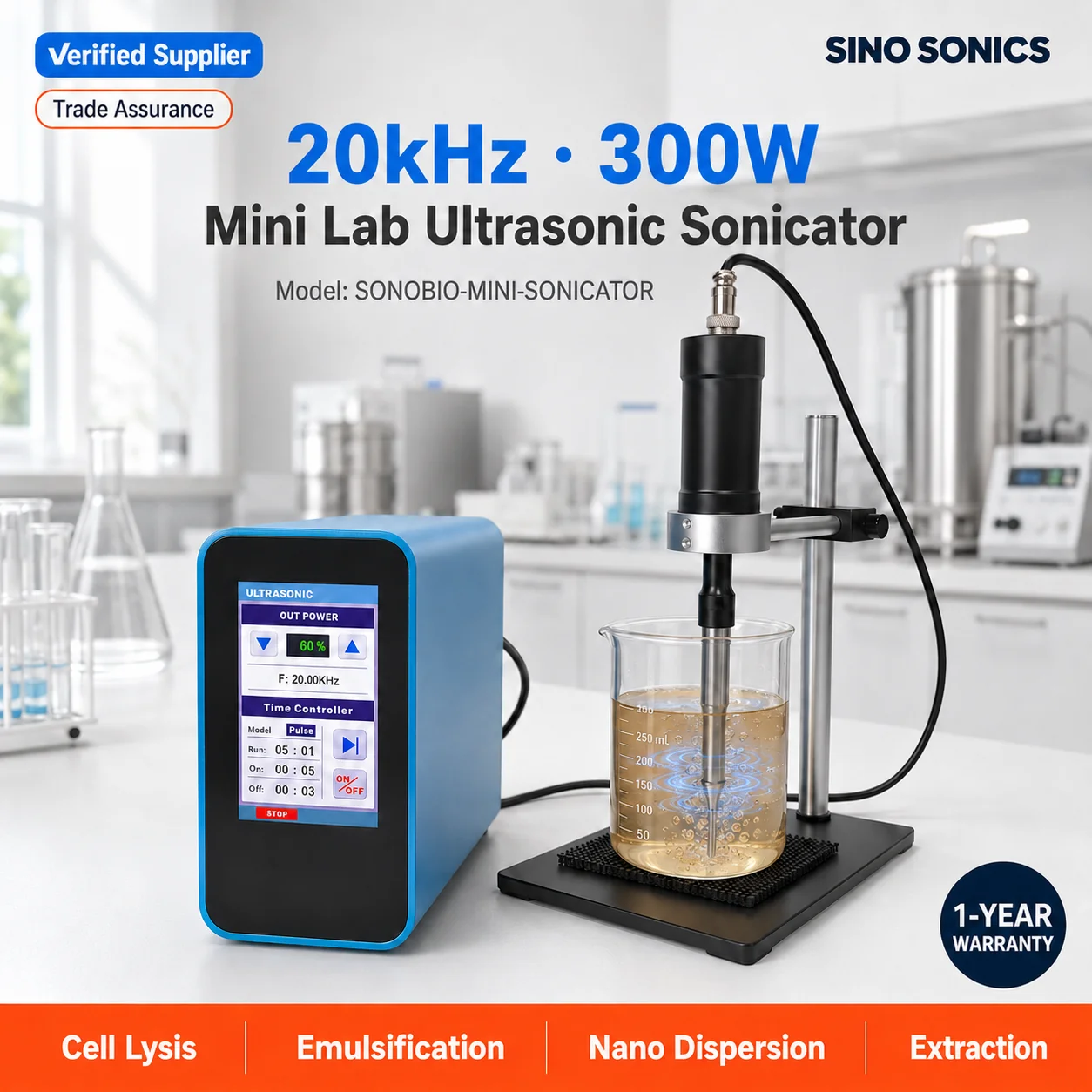
Among the available techniques — bead beating, enzymatic digestion, French press, nitrogen cavitation — ultrasonic homogenization has become the standard in modern labs for one simple reason: it gives you direct control over how, how hard, and how long you disrupt your cells. This guide walks you through the complete protocol: how it works, how to choose the right probe, parameter settings by sample type, and the five mistakes we see most often in client labs.
How Ultrasonic Cell Lysis Works
When an ultrasonic probe vibrates at 20 kHz, it generates millions of microscopic bubbles in the surrounding liquid. These bubbles collapse violently in milliseconds — a phenomenon called cavitation — releasing micro-jets of liquid moving at hundreds of meters per second.
These micro-jets physically shear cell membranes. Unlike chemical lysis (which can denature proteins) or freeze-thaw (which is slow and inefficient), ultrasonic lysis is mechanical — and it can be tuned in real time.
| Method | Speed | Protein Integrity | DNA Shearing | Equipment Cost |
|---|---|---|---|---|
| Bead beating | Medium | Medium | Severe | Low |
| Enzymatic | Slow | High | Minimal | Very low |
| French press | Fast | Medium | Minimal | High |
| Ultrasonic | Fast | High (with ice bath) | Controllable | Medium |
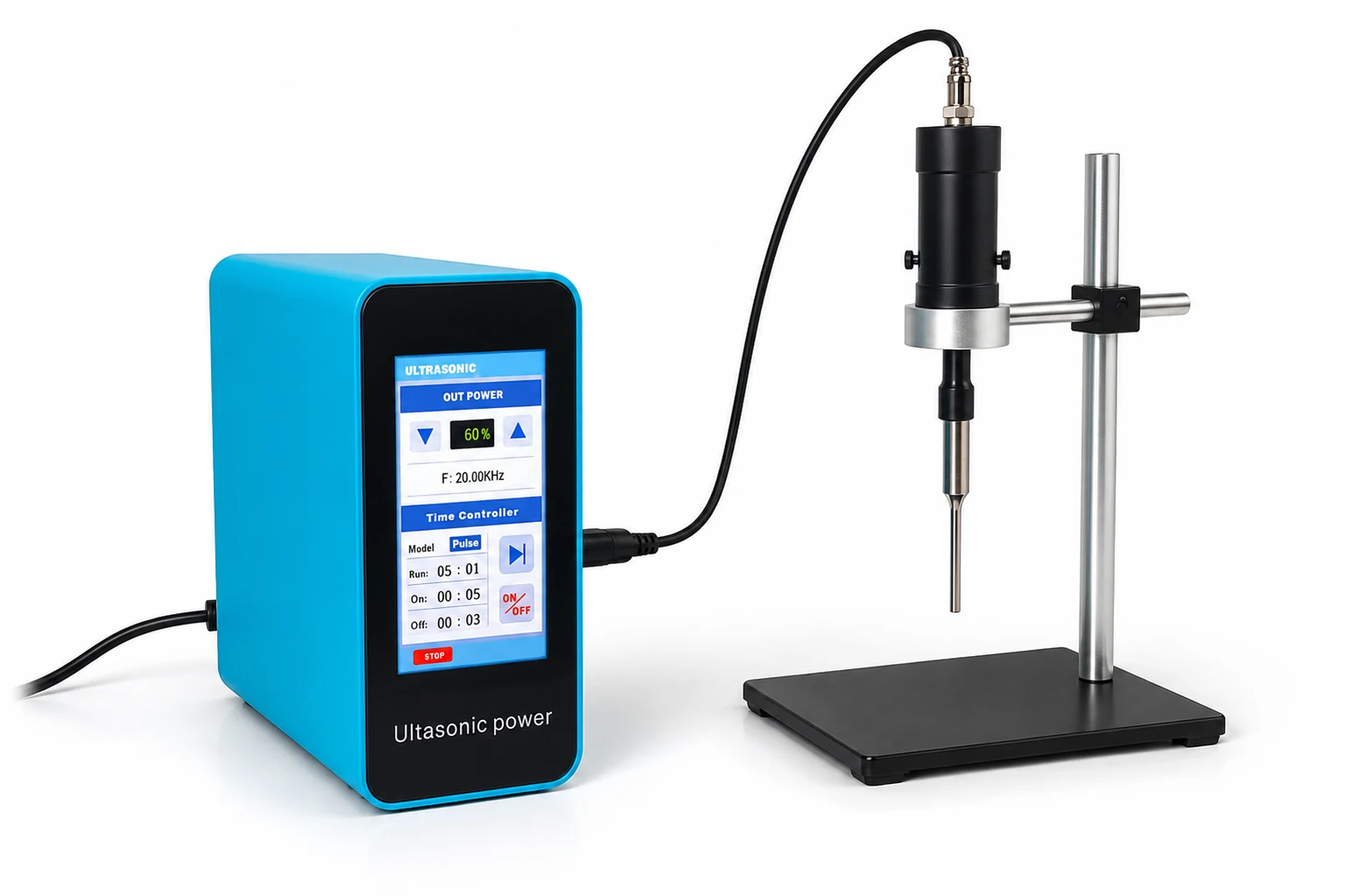
The four variables you control are: frequency (typically 20 kHz), amplitude (% of maximum vibration), pulse mode (on/off cycles), and total processing time. Master these four, and you control your lysis.
Choosing the Right Probe
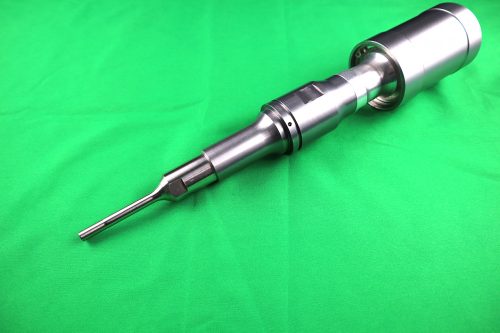
The probe is more than just an accessory — it determines whether your sample lyses cleanly or burns up.
Probe Diameter by Sample Volume
| Sample Volume | Probe Tip Diameter |
|---|---|
| 50–500 μL | 2 mm microtip |
| 0.5–5 mL | 3–6 mm probe |
| 5–50 mL | 13 mm probe |
| 50–250 mL | 19 mm probe |
| 250 mL – 5 L | 25 mm probe (with booster) |
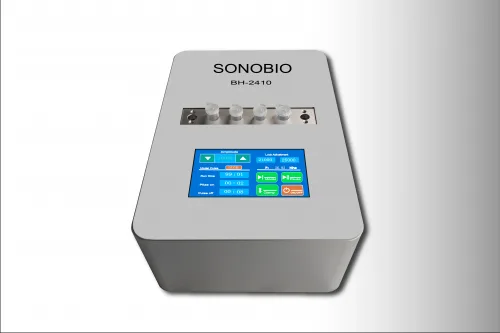
Mismatch probe and volume, and energy distribution becomes uneven — some cells over-process, others under-lyse. For 50–200 mL field samples, a portable system like the SONOBIO Handheld Ultrasonic Homogenizer is ideal. For benchtop work up to 5 L, the SONOBIO Integrated Ultrasonic Homogenizer covers most lab applications.
Probe Material: Titanium Alloy vs Stainless Steel
This is the silent killer of many experiments: stainless steel probes release iron and chromium ions into your sample over time. For metal-sensitive assays — protein crystallization, enzyme activity studies, mass spec — these contaminants can ruin results.
Titanium alloy probes are corrosion-resistant and biocompatible. They cost more upfront but eliminate metal contamination entirely. SONOBIO probes are titanium alloy by default, which is why they are standard in pharmaceutical and biotech labs.
The Complete Protocol
Setup
- Ice bath is non-negotiable. During lysis, sample temperature can rise 2–5 °C in seconds. Without cooling, proteins denature and enzymes lose activity. Place sample tubes in an ice bath or use a chilled jacket — not optional.
- Probe immersion depth. Submerge the probe tip 2/3 into the liquid. Too shallow, and you will create foam; too deep, and you will dampen vibrations.
- Avoid air contact. Air bubbles dissipate cavitation energy. Keep the tip well below the surface throughout.
Parameters by Sample Type
| Sample Type | Frequency | Amplitude | Pulse | Total Time |
|---|---|---|---|---|
| Bacteria (E. coli, B. subtilis) | 20 kHz | 30–50% | 5s on / 5s off | 2–3 min |
| Yeast (S. cerevisiae) | 20 kHz | 60–80% | 10s on / 10s off | 3–5 min |
| Mammalian cells (suspension) | 20 kHz | 20–30% | 3s on / 5s off | 1–2 min |
| Soft tissue | 20 kHz | 70–90% | 5s on / 10s off | 5–10 min |
| Fungal spores | 20 kHz | 80–100% | 10s on / 20s off | 8–15 min |
Key insight: amplitude is inversely proportional to cell fragility. Mammalian cells (no cell wall) need less than 30% — go higher and you shred DNA into 200 bp fragments, ruining downstream ChIP or long-read sequencing. Spores need maximum amplitude because their walls are nearly bulletproof.
Verification
- Visual: Lysate should turn from cloudy (intact cells) to translucent (membranes broken).
- OD measurement: OD600 should drop by 80% or more after lysis.
- Microscopy: DAPI staining should show no intact nuclei in mammalian samples; bacteria should appear as fragments under phase contrast.
5 Common Mistakes (and How to Fix Them)
1. Skipping the ice bath. Sample heats during lysis; proteins denature. Fix: Always lyse in an ice bath. Use shorter pulses with longer rest intervals (5s on / 15s off) for heat-sensitive samples.
2. Probe too close to bottom or wall. Energy reflects unpredictably; some cells over-process while others escape. Fix: Center the probe in the tube, immersed 2/3 deep, at least 5 mm above the bottom.
3. Foaming. Foam introduces air, which kills cavitation efficiency and denatures surface-active proteins. Fix: Submerge the probe deeper. If your sample is prone to foaming (high protein, surfactants), add 0.05% antifoam agent.
4. Too much amplitude on mammalian cells. Excessive amplitude shears DNA into fragments under 1 kb — fatal for ChIP-seq, Hi-C, and long-read library prep. Fix: Run an amplitude titration first. Find the lowest amplitude that achieves 70% lysis while keeping fragments above 10 kb.
5. Inconsistent volume across samples. A 1 mL sample lyses differently than a 5 mL sample at the same settings. Fix: Standardize sample volume in your protocol; use the same probe size across replicates.
Troubleshooting
| Problem | Likely Cause | Solution |
|---|---|---|
| Low lysis efficiency | Amplitude too low / probe too far from bottom | Increase amplitude by 10%; reposition probe |
| Sample heats rapidly | No ice bath / pulse interval too short | Add ice; switch to 5s on / 15s off |
| Visible probe wear | Amplitude too high / wrong material | Reduce amplitude; switch to titanium alloy detachable tip |
| Heavy foaming | Probe too shallow / surfactant in sample | Submerge deeper; add antifoam |
| Inconsistent results between runs | Volume varies / probe aging | Standardize volume; replace tip every ~500 hours of use |
When to Upgrade Your Equipment
Three signs you have outgrown your current setup:
- Volume creep: You are routinely processing more than 5 L. A handheld system cannot deliver enough energy density. Look at industrial-scale models like the SONOBIO Integrated Ultrasonic Homogenizer or split-type continuous-flow systems.
- Contamination concerns: For sensitive applications (cell culture, primary stem cells, sterile pharmaceuticals), consider non-contact ultrasonic systems where the probe never touches the sample.
- Field sampling: Running lysis at customer sites or remote labs? A portable handheld unit (SONOBIO Handheld) lets you process samples within minutes of collection — critical for RNA-grade work.
If you are not sure which configuration matches your application, request a free sample test. Send us your sample type and processing volume; we will demonstrate on the actual probe size you would need before you commit to a purchase.
Conclusion
Successful cell lysis comes down to four things: the right probe, the right amplitude, the right pulse cycle, and a non-negotiable ice bath. Get those right, and you will cut your downstream failure rate dramatically — Western blots will be cleaner, RNA yields will be higher, and downstream sequencing data will reflect the biology of your sample, not the artifacts of your lysis.
This is the first article in a six-part series on ultrasonic sample preparation. Next week: DNA shearing protocols with ultrasonic homogenizer — fragment sizing, ChIP-seq optimization, and Covaris-equivalent results without the cost.
Related posts


Popular products
-
 35kHz 300Watt-D30-SA
Original price was: $220.00.$170.00Current price is: $170.00.
35kHz 300Watt-D30-SA
Original price was: $220.00.$170.00Current price is: $170.00.
-
Impedance Analyzer PV520A-T (1KHz~3MHz)
Original price was: $3,200.00.$2,750.00Current price is: $2,750.00.
-
35kHz 1000Watt F30-ST-1
Original price was: $280.00.$220.00Current price is: $220.00.
-
20kHz 1200Watt Branson 900 Replacement
Original price was: $300.00.$260.00Current price is: $260.00.
-
35kHz 900Watt Spot Welding Set
Original price was: $240.00.$200.00Current price is: $200.00.
-
20kHz 2000Watt Transducer (Aluminum Housing)
Original price was: $360.00.$330.00Current price is: $330.00.
-
 Ultrasonic Food(Cake,biscuit)Cutter/Cutting Machine/Blade
Price range: $1,500.00 through $1,700.00
Ultrasonic Food(Cake,biscuit)Cutter/Cutting Machine/Blade
Price range: $1,500.00 through $1,700.00
-
SoniKKs 35kHz 1200watt Replacement
Original price was: $280.00.$250.00Current price is: $250.00.
-
20kHz 2000Watt Spot Welding Set
Original price was: $300.00.$260.00Current price is: $260.00.
-
35kHz 900Watt 35FA915-1
Original price was: $250.00.$207.00Current price is: $207.00.
-
Telsonic 36kHz 1000watt Replacement
Original price was: $580.00.$550.00Current price is: $550.00.
-
35kHz 800Watt F25-SA-1
Original price was: $240.00.$207.00Current price is: $207.00.
-
SONOBIO Non-Contact 4 Channel Ultrasonic Homogenizer/ Sonicator
Original price was: $4,000.00.$2,599.00Current price is: $2,599.00.
-
40kHz 900Watt F30SA1
Original price was: $250.00.$220.00Current price is: $220.00.
-
Piezo Ceramic Ring Φ60mm
Original price was: $17.00.$15.50Current price is: $15.50.