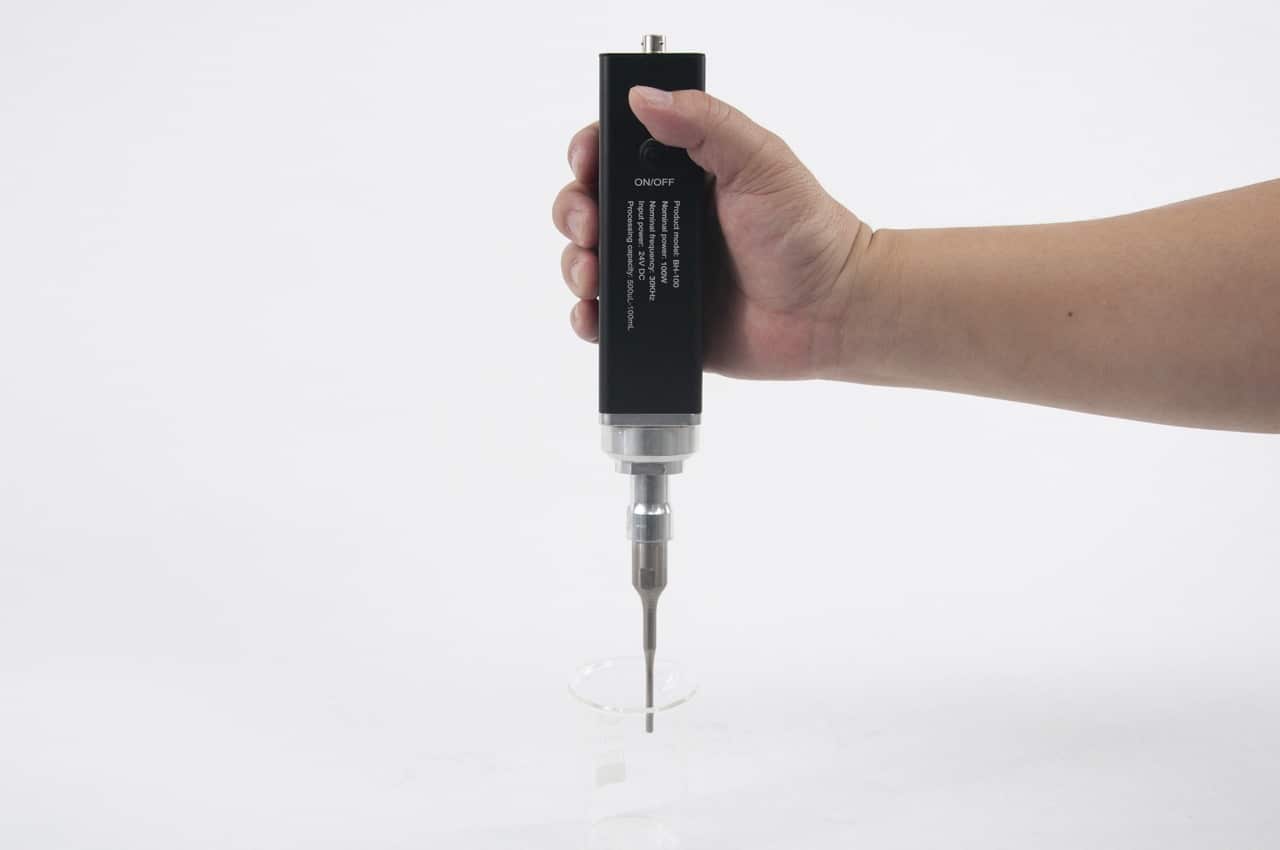
A handheld ultrasonic homogenizer is the portable cousin of a benchtop sonicator — usually a 20 kHz device under 1.5 kg, drawing 50 to 150 watts, designed for sample volumes between 0.5 mL and roughly 500 mL. For labs that need cavitation chemistry but can’t dedicate bench space, or research teams running mobile fieldwork, a handheld ultrasonic homogenizer is often the difference between a usable workflow and an awkward one. The trade-offs are real, though: a portable unit will never disrupt 2 liters of biomass the way a 1,000 W benchtop will, and the probe geometry is the limit, not the generator. So the right question isn’t “is handheld good enough?” — it’s “is your sample volume, target particle size, and protocol duration inside the handheld envelope?” This guide walks through the four specifications that matter (frequency, rated power, probe size, duty cycle), the lab applications where portable genuinely beats benchtop, and a five-question buying checklist you can take into any vendor conversation. We’ll close with the spec sheet for SonoSonics’ SONOBIO 150 W unit so you have a concrete reference point — but the framework works for any handheld ultrasonic homogenizer you’re evaluating.
💡 Need to compare a handheld unit against a 500 W benchtop for your protocol? Request a free spec comparison — we’ll send a side-by-side PDF within one business day.
What “handheld” actually means in ultrasonic homogenization
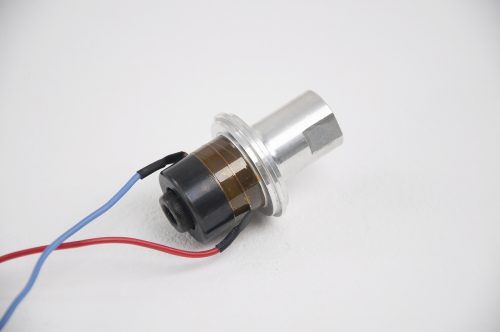
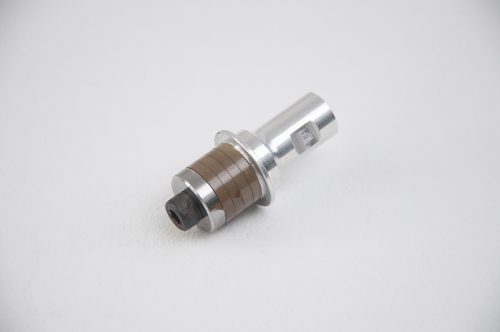
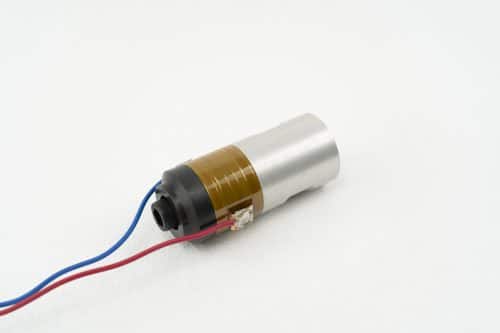
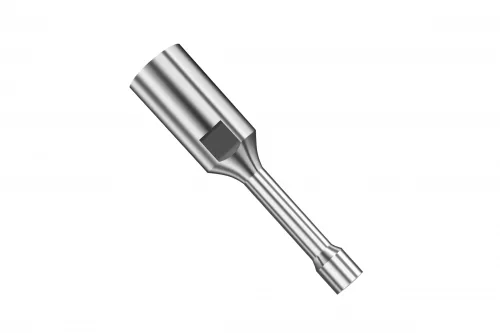
In the ultrasonic equipment world, “handheld” isn’t just a size descriptor — it’s a different power and probe-geometry class. A handheld ultrasonic homogenizer typically runs at 20 kHz, draws 50 to 150 watts, weighs under 1.5 kg, and ships with a stepped horn that accepts probe tips from 2 mm up to about 10 mm in diameter. The whole unit fits in a lab cart drawer or a field-sampling case.
By contrast, a benchtop sonicator sits at 300 to 1,000 W, requires a sound enclosure box, and is engineered for sample volumes from 5 mL up to several liters. An industrial inline homogenizer climbs into the 1,000–3,000 W range with flow-through reactors. The same physics — cavitation generated by a vibrating titanium probe — but the engineering envelope is completely different.
Where does a handheld unit fit in a real lab workflow? Three places, mostly:
- Pilot screening. Before committing to a 5 L reactor process, R&D teams use a handheld unit to test dispersion or extraction protocols on 50 mL of feedstock.
- Mobile field sampling. Environmental and clinical-research groups carry handheld sonicators into the field for sample prep where bringing a benchtop is impossible.
- Micro-batch QC. Cosmetic and pharma R&D groups run small batches of emulsion or nanoparticle suspension through a handheld unit when production is somewhere else entirely.
If your protocol fits one of those three patterns, a handheld ultrasonic homogenizer is almost certainly the right choice over a benchtop.
Frequency trade-offs — 20 kHz vs 40 kHz for portable units
Almost every handheld ultrasonic homogenizer on the market operates at 20 kHz. That’s not arbitrary. At 20 kHz, the cavitation bubbles formed in your liquid sample collapse with enough energy to break cell membranes, de-agglomerate nanoparticles, and shear emulsion droplets down to sub-micron sizes. It’s the workhorse frequency for everything from E. coli lysis to graphene dispersion.
Some equipment vendors advertise 40 kHz handheld units, often pitched as “gentler” or “more precise.” There is some truth to this: 40 kHz produces finer cavitation with less aggressive shockwaves, which can matter for protein-sensitive protocols. But here’s the practical reality — at 40 kHz, the cavitation energy density drops substantially. For most disruption and dispersion work, a 40 kHz handheld unit will need 3–5× longer processing time to hit the same result. Unless you’re specifically working with shear-sensitive biologics, 20 kHz is the right default.
For sample volumes above 500 mL, the calculus changes. Frequency matters less than rated power and probe tip geometry. If you’re routinely processing 250 mL or more, a benchtop ultrasonic homogenizer is a better investment than a handheld unit running at the upper edge of its envelope.
Probe size and sample volume matrix
The single most important sizing decision in any ultrasonic homogenizer protocol is matching probe diameter to sample volume. Get this wrong and you’ll either waste energy (oversized probe in a small tube cavitates the air-water interface, not the bulk) or lose efficiency entirely (undersized probe in a large beaker only processes a small zone around the tip).
Typical handheld ultrasonic homogenizer probe sizing:
- 2 mm probe → 0.5–10 mL sample volume. Eppendorf tubes, micro-centrifuge tubes, single-cell-prep work. Use a stand or clamp; freehand operation introduces motion artifacts.
- 6 mm probe → 10–100 mL. The most common workhorse probe for lab-scale work. Cell lysis, small-batch emulsification, nanoparticle dispersion.
- 10 mm probe → 100–500 mL. Pushing the upper edge of what a handheld unit can do. Expect longer cycle times; 150 W of input power across a 500 mL beaker is borderline.
One non-negotiable spec: the probe material should be Ti-6Al-4V titanium alloy, not aluminum. Aluminum probes erode in under 50 hours of cumulative cavitation contact, releasing aluminum particles into your sample (which is catastrophic for any analytical chemistry workflow). Titanium probes last 500+ hours under normal lab use. If a vendor offers “aluminum” or “stainless steel” as a probe option, that’s a sign of cost-cutting at the expense of contamination control.
Lab applications where portable beats benchtop
Most lab managers default to “we should buy a benchtop unit” because that’s what was in their grad school lab. But for several specific application classes, a handheld ultrasonic homogenizer is genuinely the better tool:
- Field water sampling for ICP-MS prep. Turbidity reduction in 50–100 mL samples, performed at the collection site so analytes don’t shift during transport. A benchtop unit is irrelevant here — you can’t carry it.
- Cell lysis inside a BSL-2 biosafety cabinet. Many BSL-2 cabinets simply don’t have the depth for a benchtop sonicator. A handheld unit fits, and the sound footprint is lower (most handheld units run quieter than the cabinet’s own fan).
- Pilot dispersion screens for nanoparticle work. Before scaling a TiO₂ or graphene oxide protocol to production, R&D teams run 50 mL pilots. A handheld unit’s smaller probe-to-volume ratio mimics the production reactor’s edge effects better than an oversized benchtop probe.
- Cosmetic and pharma small-batch emulsion R&D. Formulation scientists testing 20–50 mL prototype emulsions don’t want to fire up a 750 W benchtop unit for each iteration. Handheld is faster and uses less probe surface per batch.
If your protocol is one of these, the question isn’t “handheld or benchtop?” — it’s “which handheld unit?” For deeper background on ultrasonic homogenization in biological applications, see our companion guide on cell lysis with ultrasonic homogenizers.
Buying checklist — five questions to ask any vendor
Before you sign a PO for a handheld ultrasonic homogenizer, get clear answers to these five questions. A vendor who can’t answer them in 30 seconds doesn’t understand the equipment they’re selling.
- What’s the maximum sample volume per pulse, and at what duty cycle? “150 W” is meaningless without a duty-cycle qualifier. Real spec should read: “150 W continuous up to 30 seconds at 100% duty, indefinite at 30–50% duty.”
- Can the probe tip be replaced without sending the unit back to the factory? Field-replaceable probes save weeks of downtime. Some bargain units have welded probe stacks — avoid them.
- Is pulse mode adjustable from 10% to 90% duty cycle? Pulse mode prevents sample heating and is essential for protein and biological work. A unit with only continuous-mode operation is a deal-breaker for any thermally sensitive protocol.
- Does the unit ship with a sound enclosure box? Handheld units routinely produce 85+ dB at the operator’s ear. OSHA exposure limits are an issue. The good vendors include an acoustic enclosure standard.
- What’s the warranty on the transducer stack, separately from the generator? Transducers fail. Generators usually don’t. A unified 1-year warranty often masks a 6-month transducer guarantee. Ask for the breakdown.
If a vendor stumbles on any of these, push back or move on.
When NOT to choose a handheld unit
Handheld is not always the right answer. A short list of scenarios where you should pick something else:
- Continuous flow processing. Anything involving inline reactors, peristaltic feed loops, or multi-liter throughput should use an industrial inline sonicator, not a handheld.
- Volumes above 500 mL per batch. You’ll be running the unit at the edge of its duty cycle every time. A 750 W benchtop unit is faster and won’t burn out.
- Production-scale GMP environments. Handheld units rarely have the documentation (IQ/OQ/PQ) that GMP audits demand. Fixed benchtop or industrial units are the standard.
- Protocols requiring temperature control. No handheld unit has integrated water-jacketed cooling. If your sample must stay below 10°C during sonication, you need a benchtop unit with a cooling sleeve or a flow-cell setup.
If any of these apply, stop reading buyer’s guides for handheld units and start sourcing benchtop or industrial equipment.
SonoSonics SONOBIO 150 W — quick spec callout
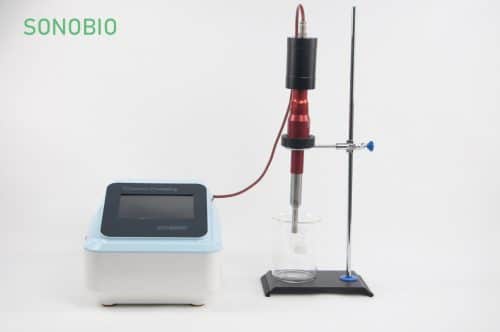
For a concrete reference point, here are the headline specs on our own SONOBIO 150 W portable ultrasonic homogenizer:
- Frequency: 20 kHz
- Rated power: 150 W
- Sample volume range: 0.5–250 mL
- Standard probe: 6 mm Ti-6Al-4V titanium alloy (3 mm and 10 mm available)
- Pulse mode: 10–100% duty cycle, adjustable in 5% increments
- Display: LCD timer, real-time wattage, cumulative energy
- Weight: 1.2 kg (handheld), 3.5 kg (with stand)
- Acoustic enclosure: included
If you’re sizing a portable unit and want to compare specs against a vendor you’re already talking to, request the SONOBIO datasheet and we’ll send it the same day.
Frequently asked questions
What’s the difference between a sonicator and an ultrasonic homogenizer?
The terms are largely interchangeable in modern usage. Historically, “sonicator” was associated with cleaning baths and “homogenizer” with probe-based disruption, but vendors and labs use both words for the same probe-style equipment. When in doubt, look at the spec sheet — if it lists a probe and a 20 kHz frequency, it’s a homogenizer regardless of what the box says.
Can a handheld ultrasonic homogenizer disrupt bacterial cells?
Yes, comfortably. 150 W at 20 kHz lyses E. coli and most Gram-negative bacteria in 30–60 seconds for 10 mL volumes, and 2–3 minutes for 100 mL. Gram-positive bacteria (thicker cell walls) take 2–3× longer. Always pulse to control temperature.
How long does an ultrasonic probe last?
A titanium probe used in standard lab conditions (water-based samples, no hard particulates) lasts 500–1,000 hours of cumulative cavitation contact. Heavy abrasive work (nanoparticle slurries) drops that to 200–300 hours. Tips erode at the cavitation face — when surface roughness becomes visible to the naked eye, replace it.
Is 20 kHz safe for proteins?
With pulse-mode operation and temperature control, yes. Continuous-mode 20 kHz sonication will denature most proteins within 5 minutes due to localized heating and shear stress. The standard protein-safe protocol is 10–30 seconds on, 30–60 seconds off, with the sample on ice.
Next steps
If a handheld ultrasonic homogenizer fits your workflow, the path forward is straightforward. Make sure you’ve answered the five buying-checklist questions for whichever vendor you’re evaluating, confirm the probe is Ti-6Al-4V, and verify the pulse-mode range matches your most thermally sensitive protocol.
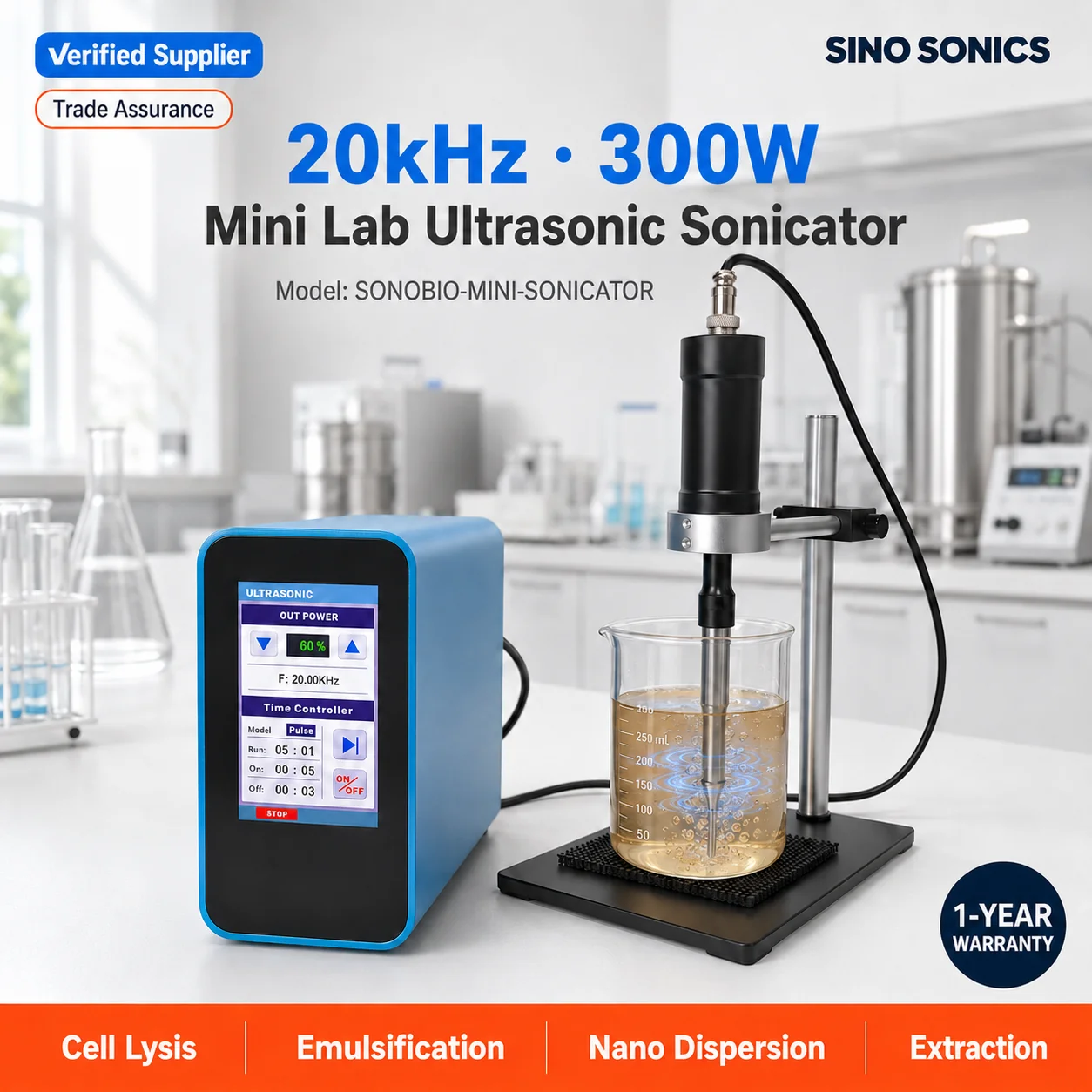
Looking at the SONOBIO 150 W or a 300 W lab benchtop? Talk to a SonoSonics application engineer — typical response under 24h, no sales-script gauntlet.
Related posts


Popular products
-
 20kHz 1200Watt Branson 900 Replacement
El precio original era: $300.00.$260.00El precio actual es: $260.00.
20kHz 1200Watt Branson 900 Replacement
El precio original era: $300.00.$260.00El precio actual es: $260.00.
-
35kHz 900Watt F30-SA-P
El precio original era: $250.00.$207.00El precio actual es: $207.00.
-
Impedance Analyzer PV520A-S (1KHz~1MHz)
El precio original era: $2,600.00.$2,350.00El precio actual es: $2,350.00.
-
 15kHz Booster; Gain 1:2.5
El precio original era: $180.00.$165.00El precio actual es: $165.00.
15kHz Booster; Gain 1:2.5
El precio original era: $180.00.$165.00El precio actual es: $165.00.
-
28kHz 600Watt F30-SA-1
El precio original era: $208.00.$184.00El precio actual es: $184.00.
-
SONOBIO Split-type Ultrasonic Homogenizer/Sonicator
Rango de precios: desde $1,399.00 hasta $1,899.00
-
35kHz 900Watt Spot Welding Set
El precio original era: $240.00.$200.00El precio actual es: $200.00.
-
20kHz 2000Watt F50-SA
El precio original era: $220.00.$180.00El precio actual es: $180.00.
-
35kHz 300Watt-D30-SA
El precio original era: $220.00.$170.00El precio actual es: $170.00.
-
35kHz 800Watt F25-SA-1
El precio original era: $240.00.$207.00El precio actual es: $207.00.
-
15kHz 2600Watt F60-SA-1
El precio original era: $280.00.$220.00El precio actual es: $220.00.
-
Impedance Analyzer PV520A-V (1KHz~5MHz)
El precio original era: $4,250.00.$3,650.00El precio actual es: $3,650.00.
-
Ultrasonic homogenizer Probe, Lab Sonicator homogenizer Accessories, Probe Φ3 Φ6 Φ8 mm, Titanium Alloy
Rango de precios: desde $139.00 hasta $159.00
-
40khz 400Watt D30-SA-P
El precio original era: $220.00.$184.00El precio actual es: $184.00.
-
20kHz 2000Watt Ultrasonic Generator
El precio original era: $1,000.00.$900.00El precio actual es: $900.00.